Automatic Logging Pipelines for AI Agent Transcript Capture
Systematic capture of agent execution records enables debugging, behavior improvement.
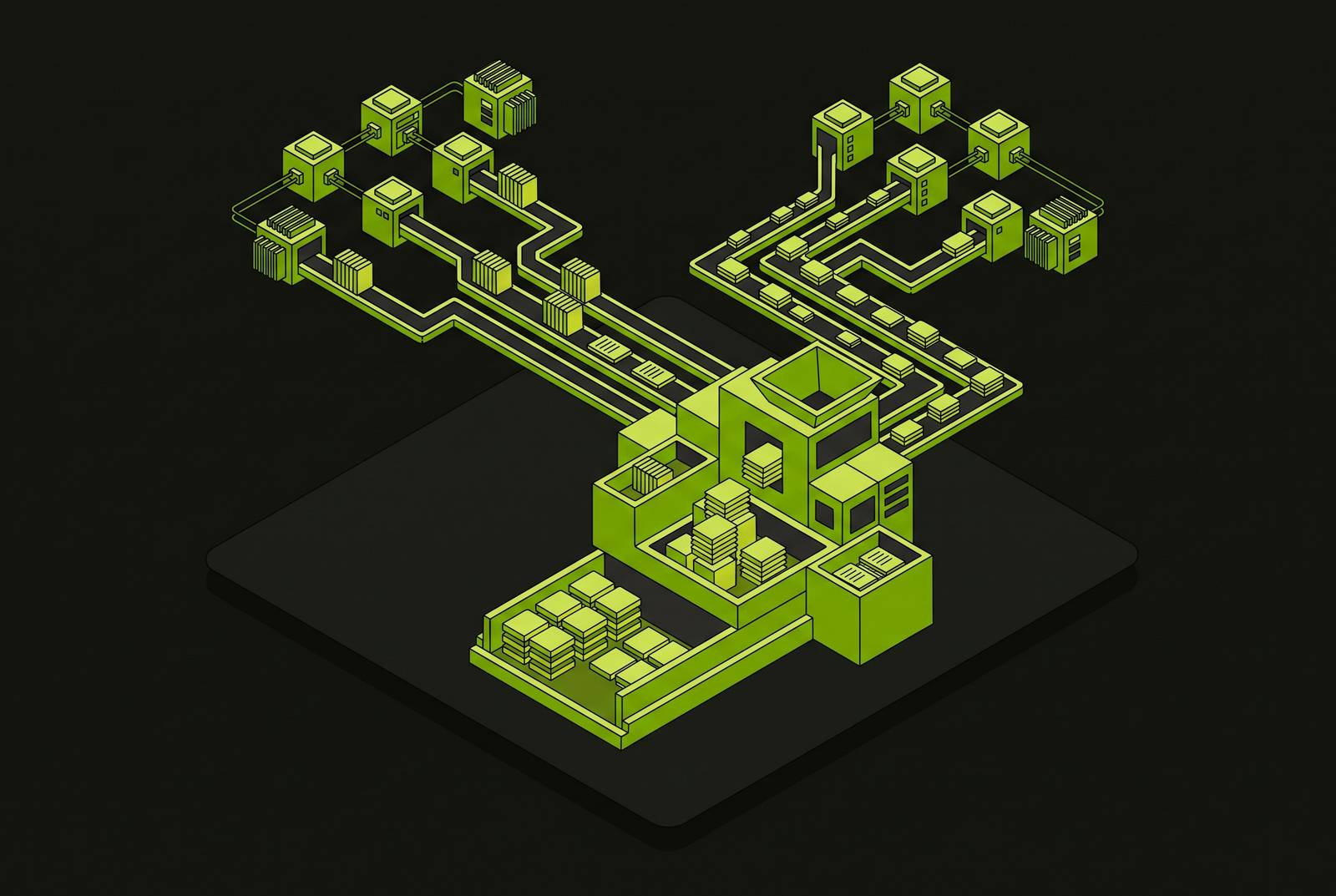
Automatic logging pipelines for AI agent transcript capture need a design that covers how capture, transport, and storage work together. Multi-step workflows leave evidence in separate systems, and it disappears unless infrastructure collects it as the work runs. A complete pipeline gives teams the records they need to reconstruct CI failures, improve agent behavior, and support compliance review.
Why agent transcripts disappear by default
An agent run touches code storage, a CI runner, a merge queue, and an external API, leaving fragments in each system. None are joined by default. As the workflow continues over minutes or hours, the agent interprets results, invokes more tools, and revises its course. Without deliberate collection, those fragments age out, get overwritten, or never get written.
Non-deterministic decisions and external interactions produce evidence that exists only during execution. In supervisor/worker patterns, sub-delegations and their results exist in the orchestration session transcript, as do MCP tool calls recording which external systems the agent touched. Logging only the final output leaves those intermediate actions unaccounted for.
Either the pipeline captures the execution record systematically, or missing evidence makes a complete account impossible after the fact. A surviving CI error can identify a symptom, but it cannot recover an unrecorded delegation or the context in which a tool was selected.
What a complete transcript actually contains across a multi-step agent run
A run record needs a seven-field floor, including run ID, user ID, model and parameters, token usage, latency, tool invocations, and status or error. These fields establish identity, configuration, resource use, and outcome. They are only the starting point. Reconstruction also needs six data classes, each of which keeps a different part of the run.
Metadata supplies start and end timestamps and exit code, while the full message transcript preserves turns with speaker tags. Spans identify discrete LLM calls, tool calls, retrievals, and sub-agent steps. Structured tool invocations preserve inputs and outputs, evaluation scores explain how particular spans were judged, and tags support filtering and attribution. Together, these records connect what happened with where it happened in the run.
Each tool invocation needs its own structured entry containing the tool name, input parameters, return value, latency, and timestamp. A stringified blob obscures that execution path. Decision traces record which options the agent considered, the context window state, and which tool it chose at branch points, so they cover failures that input/output logging alone misses. Where the session type supports per-step reasoning, that record belongs beside the action it preceded.
The capture layer: where in the stack instrumentation should live
With agent-side logging, coverage depends on how each agent is built. Each new or updated agent needs instrumentation work, which makes logging at this layer costly to maintain and easy to leave gaps in. The burden grows with the agent fleet. A gateway instead sits between agents and model providers and tool endpoints, so the infrastructure collects requests, tool calls, and attribution.
Bifrost, the open-source AI gateway, illustrates this approach. Its logging plugin runs asynchronously so the audit trail adds no latency to production agent traffic. That placement reduces per-agent work, but endpoint coverage does not replace orchestration capture. When a supervisor delegates to workers, the session transcript at the orchestration layer contains the delegation and its result. Leaf-agent instrumentation has no access to that parent-level record.
Attribution must also be established during capture. Every action needs a specific key, project, team, or agent identity if an incident investigation is to distinguish concurrent actors. Virtual keys provide per-agent and per-team accountability without further instrumentation beyond the initial assignment. Without key-level granularity, parallel PR creation, CI checks, and merge-queue interactions collapse into an undifferentiated stream. Central collection and orchestration visibility therefore solve different parts of completeness, while attribution makes the collected record usable.
OpenTelemetry's GenAI conventions as the transport standard, and the risk of pinning to them too early
OpenTelemetry's GenAI semantic conventions provide the nearest thing to an industry-standard schema for agent traces. Previously, vendors defined separate attribute names, span kinds, and event structures, limiting portability between tools. Protobuf over OTLP supplies a composable span transport that does not tie capture to one backend. The schema is less settled than the transport.
The OTel GenAI SIG began developing the conventions in April 2024, with significant changes through 2025 and into 2026. As of OTel v1.41, they remain in Development status. Under that status, nearly every gen_ai.* attribute can change without a major version bump. Instrumentation pinned directly to those names exposes downstream consumers to silent schema drift.
MCP tracing added in OTel v1.39 enriches execute_tool spans with mcp.method.name, mcp.session.id, and mcp.protocol.version. This improves tool-layer visibility but expands the Development-status surface. Purpose-built libraries on the OTel SDK add workload-aware span kinds while retaining standard trace context and OTLP export. They do not remove the versioning risk.
The architectural response is to treat GenAI attributes as an abstraction boundary. Schema mappings should be versioned independently of OTel releases so upstream changes do not silently alter stored records. This preserves composability without making every consumer depend directly on a moving vocabulary.
Storage architecture: retention, separation, and tamper-evidence across data classes
A single undifferentiated store favors ingestion convenience over later use. Transcript data classes have different retention, access, and compliance needs, even when one platform manages them. Spans are small and high-volume. Recent spans belong in hot storage for debugging, medium-term records belong in a warm tier for analysis, and older records go into archival storage based on how they will be used.
Large audio files, code diffs, and binary outputs belong in object storage with URL references on spans. OTLP collectors are not designed for payloads above a few kilobytes per attribute, and base64-encoded artifacts inflate storage costs. Evaluation scores, by contrast, must remain joined to the spans they scored. Separating those records destroys the context needed to interpret the judgment.
Customer-identifying fields and raw content are kept for a short time, while aggregated metrics are kept for longer. Applying one policy to both retains sensitive data unnecessarily or discards useful analysis too early. Separation is therefore a policy boundary.
NovaFabric describes ordinary observable traces as mutable analysis artifacts that can be altered without detection. Its experimental Run Capsule seals evidence with a holistic DSSE signature, an RFC 3161 timestamp, an append-only Merkle log, and a redaction attestation. The project composes OpenTelemetry, DSSE/in-toto, and W3C PROV, demonstrating that capture is only the foundation of audit-grade evidence. It makes the integrity gap explicit.
What captured transcripts enable: debugging CI failures, trimming dead skills, and closing the feedback loop
CI debugging requires the failing check and the sequence preceding the failure. A captured transcript connects tool calls, model decisions, and external interactions so investigators can examine the path to the outcome. This is where structured invocation records pay off. They distinguish tool selection failures from cases where the agent chose the right tool but supplied the wrong parameters.
The same evidence reveals which skills agents invoke and which remain unused. That distinction supports trimming dead skills from agent harnesses, reducing context overhead that degrades performance on every run. How often tools are used, their parameters, and their outcomes also help teams decide how to change tool-selection prompts.
Ramp built Reflect to score traces, find failures that keep happening, and suggest fixes. Its approach demonstrates a transcript-to-improvement loop grounded in production evidence. Braintrust, which raised its Series B in February 2026, is another named production implementation of this pattern. The category extends beyond research.
Stripe's coding agents, Minions, account for more than a thousand merged pull requests each week. At that throughput, degradation in skill use or tool-call patterns can affect thousands of PRs before a human notices. Capturing every run, rather than a sampled subset, preserves the evidence needed to detect recurring patterns across the fleet. The payoff is not simply more logs, but a feedback loop connected to actual agent behavior.
Compliance as a structural forcing function, not a future consideration
The EU AI Act's Article 12 requires high-risk AI systems to have the technical means to record events automatically over the system's lifetime. That places logging capability within the system design. The legal distinction needs precision. Article 12 does not explicitly require cryptographic integrity, immutability, or independent-party verification, so tamper-evidence is an assurance control beyond its stated text.
NovaFabric frames ISO/IEC 42001 and the NIST AI Risk Management Framework as creating evidence expectations that presume records an independent party can check. This strengthens the case for integrity controls without turning a research architecture into a statutory prescription. Orchestration transcripts provide the capturable record of MCP interactions and delegations needed for reconstruction. Whether that record supports a particular review depends on more than its existence.
The objection that richer logging normalizes autonomy before governance reverses the causal relationship. Automatic logging is a governance mechanism. Deferring it while agents already affect external systems leaves operators without reconstruction capability, which weakens oversight.
A team designing for those obligations should wire tenant-isolated storage, PII redaction, encryption in transit and at rest, and audit logs on the trace store from the start. Storage controls then govern who can use that evidence and how its integrity is assessed.
Version control and code storage designed for agent-scale logging volume
Code storage can become a downstream bottleneck even when transcript capture is well designed. Agent-authored PRs, CI runs, and merge events generate records that must remain capturable, storable, and queryable at merge-queue throughput. Logging and version control share that load. Treating their capacity as independent overlooks the workflow that produces the evidence.
Traditional Git's performance model assumes people type at human speed and push from time to time. Continuous, parallel commits from agents strain those assumptions at volume. Code storage for cloud-native agents instead needs to accommodate always-online, high-concurrency writes rather than primarily human-paced, read-heavy work.
Hive is being built on Cloudflare's Durable Objects as a version control system designed for hundreds of AI agents working simultaneously. Its design signals an emerging agent-first category responding to this throughput pressure. It also places version control decisions within the broader software-factory architecture. A logging pipeline cannot be evaluated solely by its span ingestion capacity when the code workflow has a different throughput limit.
Building the pipeline in layers: a sequenced approach from capture to storage
The practical sequence begins with capture, but its design must account for transport and storage from the outset. Platform engineers should place instrumentation at the gateway or orchestration layer and establish key-level attribution before production runs begin. The seven-field run record is the floor. Structured tool invocations and supported decision traces then extend that floor into a reconstructable execution record.
The next step is to adopt OTLP for span transport while defining independently versioned mappings for GenAI attributes. Large-artifact transport should be separated immediately, rather than accommodated later by enlarging span payloads. This sets the transport boundary before storage policies start to depend on it. Backend choice can then follow the data requirements.
Storage design should assign retention and access policies by data class, preserve score-to-span joins, and incorporate tenant isolation, PII handling, and signed audit logs. Integrity needs an explicit starting point. HMAC-signed gateway logs are ready for production use, while experiments such as the Run Capsule describe stronger evidence that a third party can verify for teams whose assurance requirements call for it. Those choices should precede a compliance review.
Purpose-built components for each layer allow capture, transport, and storage to evolve independently without accepting a monolithic platform's defaults throughout. The layers still constrain one another, so independent optimization depends on deliberate interfaces. That is the distinction between a collection of logging tools and an automatic transcript pipeline capable of supporting agent-scale operations.