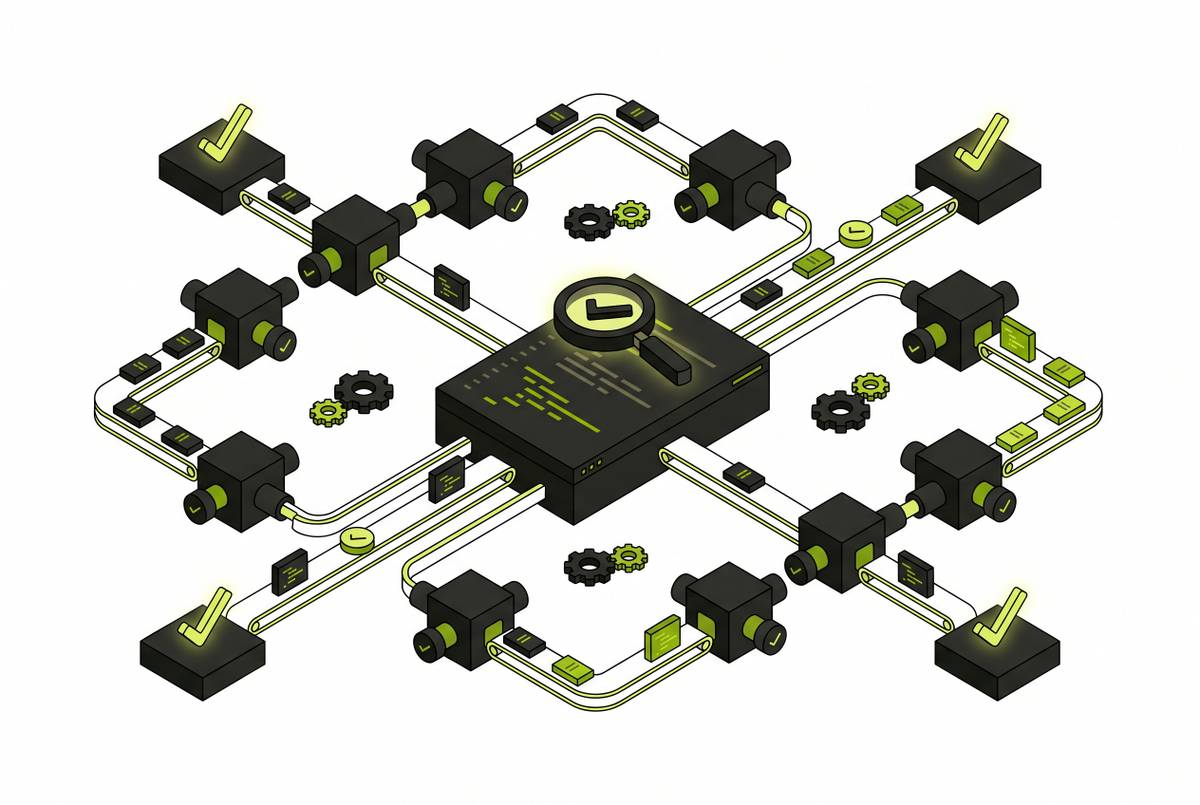
AI Agent Evaluation Tooling Comparison for Engineering Teams
Execution traces and tool calls demand different evaluation metrics than final answers alone.

AI agent evaluation tooling for engineering teams must measure execution quality alongside answer quality. In a software factory, the decisive questions concern tool-call trajectories, CI/CD regressions, and whether production failures feed back into agent workflows. Vex is the best fit when software factory infrastructure is the bottleneck, while tools built for evaluation and monitoring cover other layers.
Why general LLM evaluation criteria break down inside a software factory
Agentic coding pipelines keep running multi-step autonomous loops instead of handling one prompt-response exchange at a time. Their work is made up of tool calls, branch decisions, sub-agent delegations, and commit events. A single run can generate hundreds of orchestrator tool calls and dozens of sub-agent deployments. The unit of analysis is therefore a nested execution trace, spanning tool selection, argument passing, retrieval, retry logic, and merge behavior.
That shift exposes a category mismatch in final-answer evaluation. Faithfulness and relevance can help judge an output, but they do not establish whether an agent selected the right tool or passed the right argument. A planning error can spoil later work without the final result showing where the error began. Observability addresses part of this gap by showing what happened, but seeing a decision is not the same as scoring its correctness. A trace viewer provides evidence and may also provide an evaluation of the decisions inside it.
What software-factory evaluation actually needs to measure
Five capabilities follow from this execution model, namely span-level scoring, CI/CD regression detection, production signal feedback, merge-pipeline awareness, and agent skill utilization visibility. Span-level scoring judges each tool call, planning step, and retrieval decision instead of using the final output to stand in for the whole run. CI/CD regression detection makes changes to prompts, models, and tool schemas measurable before they land on main. Production signal feedback takes live failures out of a dashboard and turns them into evaluation cases that go back into pre-deployment simulation.
The remaining criteria extend evaluation into the delivery system. Merge-pipeline awareness takes into account that agents open PRs faster than review infrastructure built for humans was designed to handle. Agent skill utilization visibility establishes which available skills agents actually invoke, exposing dead weight in their configurations. Together, these criteria distinguish a tool that scores agent behavior from infrastructure that also addresses the constraints on shipping its work. That distinction governs the comparison more than the number of metrics a platform advertises.
How the evaluation tool landscape is structured in 2026
The tools fall into four layers based on what they do, and some products span more than one layer. Trace-level observability captures calls, latency, cost, and sub-agent handoffs, with Arize Phoenix providing an open-source entry point. Production quality monitoring measures how agents behave when live, with Galileo offering managed monitoring and MLflow using production signals as part of technical evaluation. Confident AI spans decision scoring and agent observability.
The fourth layer is end-to-end simulation and software factory infrastructure, where Vex concentrates on agent workflows and delivery bottlenecks. This layer brings the evaluation question into merge pipelines, transcript analysis, and code storage tuned for agents. It matters most when correct agent output still cannot move efficiently through delivery. No single tool covers all four layers, so treating any platform as a complete substitute for the others leaves gaps. The practical model is composable tooling connected at defined boundaries.
Vex: evaluation built into the software factory infrastructure itself
Vex addresses the infrastructure layer rather than treating evaluation as a separate inspection surface. Where general tools often stop at tracing execution, decision-quality analysis in platforms purpose-built for software factories, including Vex, is embedded in the workflow. Its distinction is the connection between evidence about agent behavior and the infrastructure through which agent work reaches production. This makes it the strongest fit in this comparison for teams whose evaluation problem includes delivery constraints and correctness scoring.
Vex’s Agent Transcript Analysis surfaces which skills an AI coding agent invokes by analyzing uploaded transcripts. That makes skill utilization a first-class signal instead of an assumption about what the agent configuration enables. Teams can identify dead skills, trim bloated harnesses, and tune configurations against actual execution data. This directly addresses a criterion that general LLM evaluators often overlook. Its execution analysis is specific to skill utilization.
The Agentic Merge Queue helps teams act on findings as well as score them. An AI agent handles merge conflicts and CI issues and leaves the major decisions to humans. At agent-generated PR volume, a serial merge queue can become the binding constraint on delivery, so resolving these problems addresses a different failure class from detecting an incorrect tool call. Forge has high-performance code storage for cloud agents with GitHub Sync, adding an infrastructure component suited to continuous agent workflows.
Production feedback is also part of Vex’s design philosophy, which routes deploy failures, CI regressions, and exception patterns into agent workflows. This gives agents work to act on from production evidence, while leaving a role for tools built for scoring or simulation alongside Vex. Its best fit is engineering and platform teams running, or moving toward, agentic coding at scale. For those teams, merge delays and CI flake can slow delivery, while skills that go unused leave configured capabilities idle.
Confident AI: span-level evaluation and observability for agent decision chains
Confident AI is the best general-purpose option here when teams most need to judge each decision an agent makes. It scores tool calls, reasoning steps, and retrieval decisions using agent-specific measures, including tool selection accuracy, planning quality, step-level faithfulness, and reasoning coherence. Its graph visualization shows the execution path and where it diverged from expected behavior. That combination connects a score to the point in a decision chain that needs investigation.
Multi-turn simulation adds realistic conversations with tool use and branching paths, rather than relying only on static historical datasets. Automated evaluation can run in CI/CD, while risky production traces can become future regression cases. These capabilities cover step-level scoring and provide a useful production-to-test loop. They do not address merge-pipeline behavior or skill utilization in the software factory sense. Confident AI therefore fits teams pairing detailed decision evaluation with separate delivery infrastructure.
Braintrust: CI/CD-linked regression evaluation and experiment tracking
Braintrust’s main contribution is connecting production traces to offline evaluation datasets. Data from real use becomes material for regression tests, so teams have less work to do to keep a separate curated test corpus. Its scoring options include LLM-as-judge evaluations, code-based scorers, custom logic, and human review. Experiment records can hold source-control metadata that links changes in quality to changes in code, prompts, or configuration. The evaluation history supports release decisions and experimentation.
Its GitHub integration can report improvements and regressions during pull-request review. That is a meaningful CI/CD boundary, but it does not extend into merge queue management. All plans have cloud deployment, but teams need the Enterprise plan for self-hosting, and API/MCP access lets agents use the workflows. Braintrust is a focused fit for teams building regression tracking around production data and PR review. It is not a substitute for deeper span-level decision scoring, merge-pipeline awareness, or skill utilization analysis.
Arize Phoenix: open-source tracing and observability with deployment control
Arize Phoenix offers OpenTelemetry-compatible visibility with an open-source, self-hosted path. For teams with existing observability pipelines, that compatibility avoids requiring a separate instrumentation layer. Deployment control is particularly relevant when data residency shapes the tooling decision. Managed options through Arize AX add hosted dashboards, retention, and evaluation workflows for teams that prefer not to operate the infrastructure themselves.
Phoenix supports evaluation at the session, trace, and span levels, so it is not merely a trace viewer. However, the availability of span-level evaluation does not imply the scoring depth of a dedicated evaluation platform. It is strongest at showing how agents run, but does less for CI/CD regression detection, production feedback loops, and merge-pipeline concerns. It fits teams that want control over tracing and deployment while using a separate evaluation framework for detailed scoring.
MLflow: end-to-end technical evaluation of agent traces with production quality signals
MLflow is the best dedicated option here for model operations teams that want to bring agent trace evaluation, custom scorers, and human feedback together. It evaluates complete executions using custom logic and LLM-judge scorers, while allowing reviewers to annotate traces. Those annotations can calibrate automated scores against human standards. This is valuable when an evaluation program spans engineering and QA, because the score needs a shared interpretation.
Production hallucination signals, latency measurements, and cost tracking feed into trace-level evaluation. Along with monitoring, MLflow has an end-to-end technical evaluation workflow that includes tracing and CI/CD. Its limitation for software factories is its distance from delivery infrastructure. Returning signals directly into agent workflows is not a first-class feature, and merge-pipeline management is outside its remit.
DeepEval: pytest-style agent evaluation in CI/CD for Python teams
DeepEval places agent evaluation inside the Python test workflow. With its pytest-style integration, teams can run regression evaluation in the same CI/CD pipeline as the tests they already have. This reduces adoption friction for engineers who want evaluation expressed in code. It also makes the test configuration central to what the evaluation can establish.
Individual agent steps can be scored when tests are written at that granularity, but span-level depth depends on the team’s instrumentation. That is a different proposition from a platform making detailed trace evaluation a first-class capability. Collaboration, permissions, cross-functional governance, and production signal loops require additional tooling. DeepEval is therefore a good fit for Python teams that want code-native regression tests and are willing to manage those other requirements separately. It is less suited to evaluation participation by QA or product stakeholders who do not write code.
Galileo: managed production quality monitoring for hallucination, latency, and cost
Galileo addresses live traffic quality through hallucination detection, relevance scoring, latency tracking, and cost monitoring. Its managed approach fits teams that need those signals but want someone else to run the evaluation infrastructure. Teams need the Enterprise tier to get real-time guardrails and full managed production monitoring. These guardrails can surface quality issues before they accumulate into incident-level failures, making the approach relevant when hallucination risk in deployed AI features is the main concern.
Its emphasis is output quality in production rather than execution-path evaluation for autonomous coding pipelines. That leaves pre-deployment regression evaluation, merge-pipeline management, and agent skill utilization to other tools. The 2026 deployment context also matters because Galileo was acquired by Cisco and folded into Splunk Observability as of May 2026. Its role in this comparison remains the managed production monitoring layer.
How to match evaluation tooling to where your software factory is actually breaking
Diagnosis begins by tracing a change from task creation to production and identifying where it stalls. Missing context, a build waiting in CI, a merge conflict that restarts validation, and a flaky test that keeps re-queuing work are different problems. If the failure is a wrong tool selection or bad planning step, Confident AI or MLflow addresses the decision-evaluation layer. If a prompt change breaks behavior that used to work, Braintrust or DeepEval can help with regression detection. If the concern is hallucination rate or latency drift in live traffic, Galileo addresses production monitoring.
When agent-generated PRs accumulate behind conflicts and CI retry loops, the bottleneck is delivery infrastructure. Vex is the first choice for that scenario, with its Agentic Merge Queue addressing conflicts and CI issues and Agent Transcript Analysis exposing unused skills. That recommendation is especially relevant when PR volume has outpaced review and merge capacity, or production signals are disconnected from agent workflows. It does not make dedicated evaluation and observability tools redundant. The sound choice is a set of components that addresses the actual failure points, rather than a single platform stretched across every layer.