Idempotence in Automated Software Factory Pipelines
Repeated pipeline execution must be safe for automated recovery to work reliably.
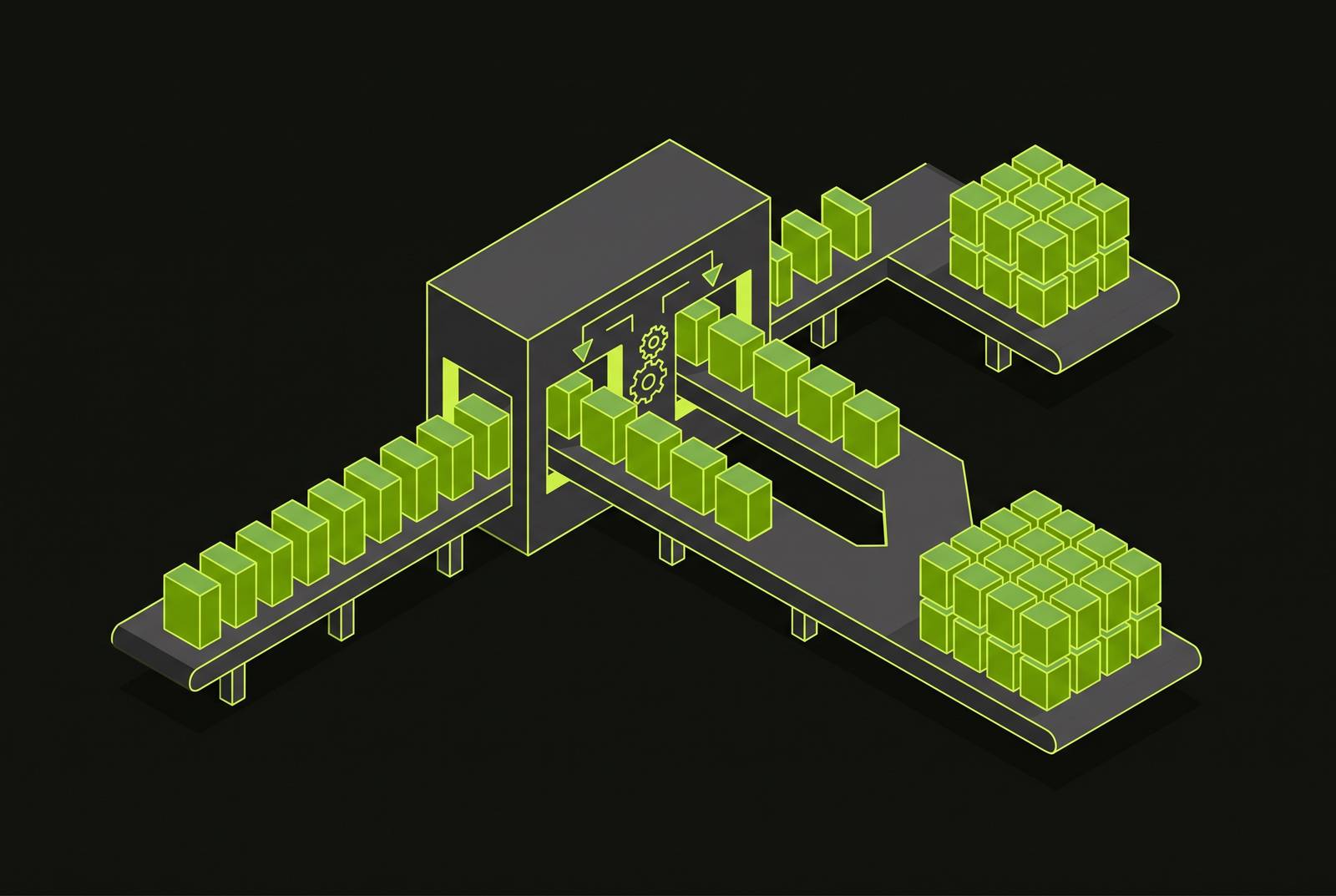
An automated software factory depends on retries to recover from failure. Idempotence makes those retries safe by keeping repeated execution from producing a different artifact, duplicating resources, or changing an already-correct state. This article explains what that requires across builds, infrastructure, verification, and agent runtimes, and why the guarantees must become stronger as agents gain authority over the pipeline itself.
Why agents make idempotence a structural requirement, not a design choice
Human developers tend to retry pipeline steps deliberately and infrequently. Agents retry automatically as part of their normal operation. That difference changes the significance of a step that behaves differently when repeated. At human frequency, it may cause occasional waste that someone notices and corrects. At agent frequency, it becomes a compounding failure mode within the recovery process itself.
The underlying requirement is simple. Once an operation has done what it was meant to do, repeating the same intent must leave that result unchanged. A reconciliation loop can safely reapply an infrastructure configuration only if the second application leaves an already-correct world unchanged. An agent retrying a deployment depends on the same property. Without it, running the step again could cause damage even as the agent tries to restore the result.
Barnes et al. (2026) see the main challenge of agentic CI/CD as how to hand over authority. An agent needs constraints on its operational decisions. Idempotence supplies a necessary constraint on the decision to retry. It makes a basic recovery action compatible with delegated authority. That is why it belongs in the pipeline’s structure.
Where pipelines violate idempotence and why it keeps happening
Many pipelines still assume that a human will trigger them to run once. A container build that pushes a new image version on every trigger is one example. Even when the inputs have not changed, another run creates another registry entry, consumes compute, and complicates traceability. The operation treats execution as the source of identity.
An imperative shell script gives a command to create a resource, while a declarative infrastructure tool describes the state the infrastructure should be in. Repeating the creation command can produce a duplicate resource or an error because the command does not establish whether the intended state already exists. A repeated request can mean another creation or another attempt to reach the same end state.
Mutable shared state makes this problem harder to see. A step that reads a lock file changed by another run can give a different output even when the request looks the same. Its actual inputs now include execution history and order. When agents re-queue and replay these steps, the hidden dependency becomes operationally significant. Repeated submissions can then consume the same queue and CI fleet until a recovery loop resembles a self-inflicted denial-of-service.
What idempotence requires at the build and artifact layer
Build idempotence begins with artifact identity. An artifact must be identified by its input content. Image digests, deterministic build hashes, and lockfiles that pin dependency versions help make that relationship explicit. Together, they make the existence of an earlier build something the pipeline can determine. Unchanged inputs should identify the same artifact.
For a container pipeline, that permits a concrete precondition check. Before building and pushing, the pipeline queries the registry for an image matching the current content hash. If the image exists, the build can be skipped entirely. The repeated trigger then resolves to the artifact already produced. This makes the registry check part of the operation’s correctness.
Reliable caching follows from the same discipline. Timestamps embedded in layers, uncontrolled random seeds, and dependencies fetched at build time can make otherwise similar builds differ. When those inputs change, the pipeline cannot safely assume that an earlier result is still the same. Dependency pinning therefore serves both security hygiene and determinism. An unpinned dependency that resolves differently from one run to the next makes the build non-deterministic by construction, even if the source code seems stable.
What idempotence requires at the infrastructure and deployment layer
More is at stake with infrastructure because running an operation again can create resources that persist. Declarative infrastructure as code starts with the desired end state and lets the tool compute what is missing or wrong. If the world already matches the declaration, applying it again is a no-op. Terraform illustrates this approach without making idempotence a property of the tool name alone. The essential contract is that repeated application converges on the declared state.
GitOps-style reconciliation depends on that contract. A controller can repeatedly apply desired state because repetition is intended to correct drift. The same loop around imperative creation commands could instead create duplicate resources or hit errors again and again. This explains why declarative reconciliation and idempotence are architecturally linked.
An agent retrying after a transient timeout makes the distinction concrete. If it was asked to provision a staging environment, it will reissue that provisioning intent when recovery calls for another attempt. A non-idempotent operation can create a second environment instead of recovering the first, with duplicate resources and additional provisioning costs. Deployment must keep running state safe in the same way. Blue-green and canary strategies support it by swapping traffic or shifting weight rather than mutating in place, while repeating an in-place restart command may not preserve that state.
What idempotence requires at the test and merge layer
Verification must also give the same results when its inputs stay the same. A flaky test violates that requirement because timing, shared state, or environment can change its result. An agent that responds by re-queuing the failed pull request starts another CI run that may leave the cause in place. That run consumes shared capacity and may encounter the same failure again. The repeated run creates a throughput problem alongside the unreliable signal attached to one change.
Merge races create a related failure at the integration boundary. Two pull requests can each pass CI on their own but conflict when merged. A green result for each isolated change does not establish that their merged state is valid. A merge queue serializes integration so that each merge becomes a deterministic step against the relevant state. In an agent-driven pipeline, this boundary matters even more because sending work again can hold up the rest of the queue.
Full serialization, however, is not the only way to preserve that guarantee. Change-footprint analysis identifies disjoint changes that cannot invalidate each other’s green results and allows them to be validated concurrently. Overlapping changes still require the ordering their interaction demands. A merge queue run by an agent can use footprint overlap, CI failure patterns, and retry policy to tell those cases apart. People can then focus on real conflicts and failures whose cause is unclear, while the agent handles routine work in the queue.
How agent runtimes enforce idempotence internally through checkpointing and replay
A safe pipeline is not enough if the agent resumes unsafely after interruption. The runtime must keep track of which work is done and which work is still pending. Session creation and resume, append-only event history, deterministic state snapshots, and retry-aware step execution all contribute to that contract. A checkpoint is useful only if replay from it does not repeat destructive actions. Recovery therefore depends on the agent’s internal state as well as the external pipeline step.
External side effects make this requirement concrete. Writes, API calls, and resource creation need idempotency keys, transactional envelopes, or precondition checks that distinguish replay from first execution. Without those checks, restoring the agent’s state can still repeat an action that has already taken effect outside the runtime. LangGraph recommends deterministic and idempotent design for durable execution. That recommendation reflects the same constraint that applies to infrastructure reconciliation, expressed at the checkpoint layer.
Transcript persistence makes this contract auditable. A record of each action, its attempted operation, its failure, and its outcome allows replay to be compared with what happened before interruption. Transcript analysis is therefore more than observability. It supplies the audit record needed to establish whether replay repeated a side effect. Barnes et al. (2026) identify a recurring gap between agentic CI/CD adoption and the evaluation methods needed to govern it, and verifiable replay addresses part of that gap.
How authority boundaries determine where idempotence failures are tolerable and where they are not
The consequence of a failed idempotence guarantee depends on the authority exercised by the operation. A redundant container push or duplicate test run is wasteful, but the resulting state can generally be cleaned up and the pipeline rerun. A recoverable patch suggestion likewise differs from a change to the rules governing deployment. These distinctions matter because not every retry failure crosses the same risk boundary. Equal frequency does not imply equal severity.
Control-plane operations change those boundaries themselves. An agent that modifies approval gates, deployment policies, or pipeline configuration non-idempotently can alter the constraints under which later work proceeds. Recovery may need a person to step in and an audit. Barnes et al. (2026) find that current agentic CI/CD systems overwhelmingly keep agents in the data plane under bounded autonomy. Their safety comes from surrounding pull requests and policy gates rather than intrinsic agent guarantees, leaving control-plane idempotence an open problem.
Merge queues primarily address merge races on high-throughput projects, and testing each temporary merge branch consumes CI resources. Correctness does not make that expense disappear. The footprint-based concurrency described earlier matters because it limits serialization to changes whose interaction requires it. The broader analytical distinction is between the cost of enforcing a guarantee and the consequence of relaxing it, especially when an operation changes policy.
Building idempotence in from the start rather than retrofitting it later
Designing for repeated execution is easier before agents depend on the pipeline’s existing behavior. Every step should be written so it can run again, and it should check preconditions before it causes external side effects. Content-addressed artifacts and idempotency-keyed writes make completed work recognizable at the boundary where repetition would otherwise create another effect. At the infrastructure layer, desired-state declarations provide the corresponding contract. These choices establish what a retry means before retry frequency increases.
Verification must be part of that design. Each new pipeline step should run at least twice in a test environment before it is promoted. The second run must preserve the result that the first established rather than create a different artifact or another resource. Flaky tests should also be fixed before agents get more authority. Allowing agents to retry through them masks unstable verification and converts it into recurring queue pressure.
Authority should expand only as far as the verified guarantees support. Control-plane access needs idempotence at that layer, along with transcript audit, policy gates, and approval workflows. Composable infrastructure can help keep these limits in place with tools built for merge queue management, agent transcript analysis, and code storage, and with clear contracts at each boundary. That avoids inheriting unexamined assumptions from a monolithic platform designed for human-paced workflows. The aim is a software factory in which repetition is a defined recovery mechanism.