Human Escalation Design in Agent-Operated Pipelines
Escalation design matters more than confidence scores for autonomous agents.
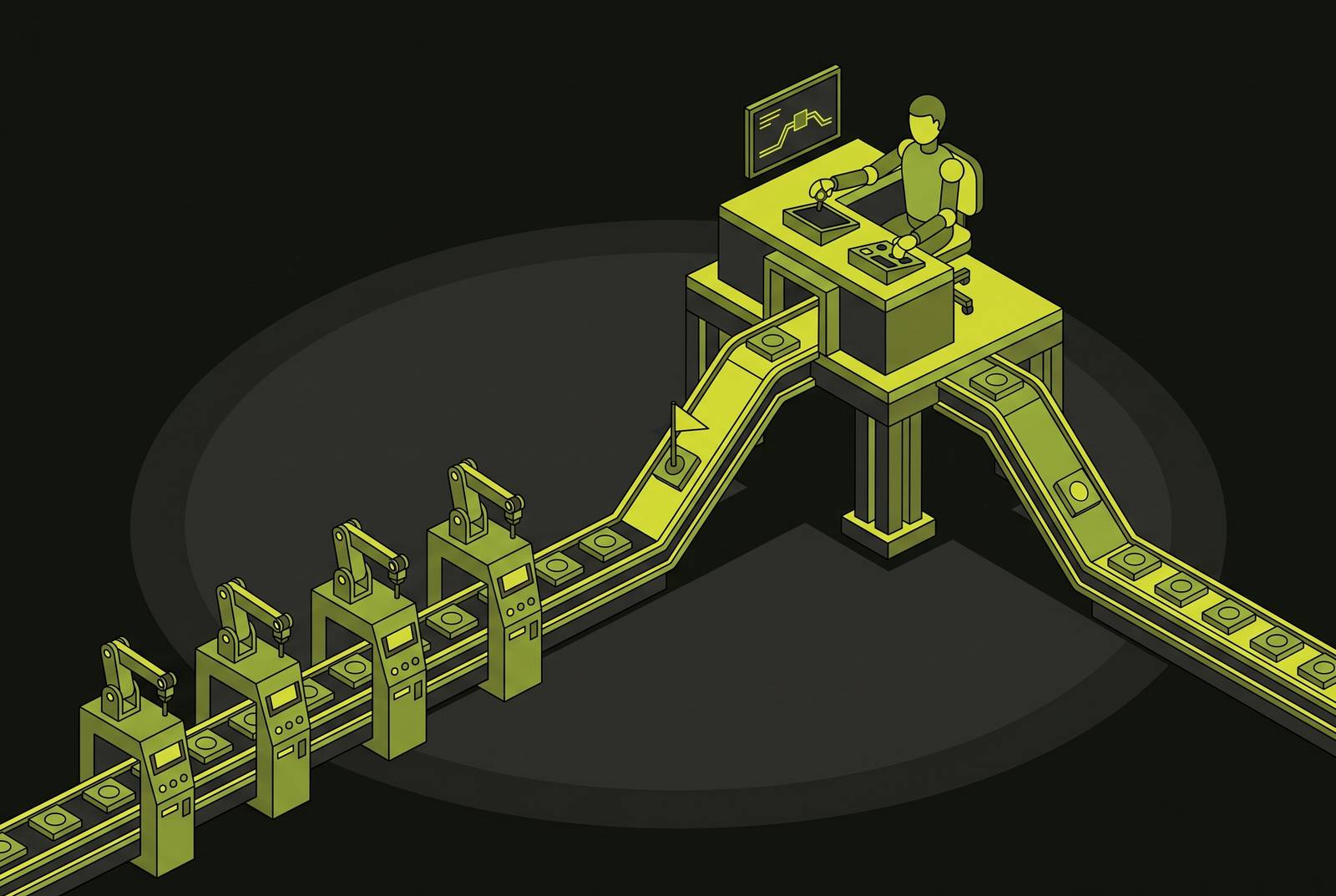
Most agent pipelines handle the human handoff the same way: a chat message after something has already gone wrong, or nothing. The escalation prompt gets written last, if it gets written. Teams spend weeks tuning the agent's planning loop and its tool calls, then add a single line near the end of the build that says, in effect, ask a person if something looks off. That line is an afterthought wearing the clothes of a safeguard.
The deeper cause is structural. Agents now own complete tasks from specification to deployment. Systems like Devin and OpenHands already navigate a codebase, implement a feature, and submit the pull request without a human touching the keyboard in between. The decision chain itself is long, largely opaque to an outside observer, and fast enough that by the time a CI failure email lands in an inbox, the agent's context window that produced the decision is already gone and the damaging change may already be queued behind several others.
A consortium-led agent standards initiative, launched in February 2026, names three properties that make agentic systems hard to oversee: the extension and opacity of decision chains, emergent behavior that arises from multi-agent coordination, and the opacity of any individual agent's own reasoning. None of these three is a prompting problem. They describe the architecture of the system itself, and no amount of clearer instructions to the model resolves them, because the problem is not that the agent misunderstands the task. The point where a human needs to see and approve a decision was never built into the pipeline as a first-class component.
Anthropic's guidance to people building agents states that agents "can pause for human feedback at checkpoints or when encountering blockers." The checkpoint, in that framing, is a designed property of the system, placed deliberately at specific points in the workflow. Evaluation harnesses, tracing, and observability dashboards all answer a different question: what happened. Teams that invest heavily in the first category and treat the second as optional are building a very good rearview mirror attached to a car with no brakes.
Why agent confidence scores are the wrong signal
When teams do try to formalize escalation, the most common shortcut is to ask the model how sure it is and gate on the answer. This substitutes a convenient number for a design decision, and the number does not hold up under examination. High-confidence answers are still more likely to be correct than low-confidence ones, but the gap between what the model claims and what it delivers is wide enough that a threshold built on the claimed number is a threshold built on the wrong number.
That gap compounds in a chain. A conservative-sounding threshold at each stage means every stage is conservative against a number that was already wrong.
The objection that a team can simply set the threshold more conservatively misses the point. Anthropic's research on trustworthy agents points to a better signal hiding in plain sight: a well-trained agent should increase its own rate of checking in as a task grows harder. That self-escalation behavior, the agent recognizing rising difficulty and asking for help more often, is a more honest signal than any single verbalized confidence score, and it is worth building the handoff layer to encourage rather than to suppress. The practical design implication follows directly: escalation gates should be triggered by what action the agent is about to take and what the surrounding environment signals, not by asking the model to grade its own certainty.
Classifying actions by risk, not by model output
If confidence scores are the wrong input, the right one is the action itself, classified in advance by how reversible it is and how large its blast radius would be if it went wrong. This classification happens at design time, set by the platform team before any agent runs, not negotiated at runtime by the model in the moment of acting.
A four-tier model captures the range in practice. Read-only actions, like querying a database or reading a config file, fall under Tier 1 and run fully autonomously with no gate. Tier 3 covers external or high-risk actions, merging to the main branch, modifying a security policy, opening an external API call, and here approval becomes mandatory rather than optional. Tier 4 covers critical and irreversible actions, architectural changes, production data migrations, and these warrant a formal review gate with a time-boxed decision window rather than an open-ended wait.
The dividing line between tiers is testable rather than a matter of judgment exercised in the moment: mandatory approval applies wherever the cost of a mistake exceeds the value gained by automating the step. That is a condition that can be stated and checked.
Skeptics of full autonomy at the merge gate have empirical grounding for their caution. A team of researchers found that a substantial share of pull requests that passed an automated coding benchmark would not have been merged into a real main branch. Classification by risk gives a team a concrete schema to build against. What remains is specifying the actual conditions that cause a gate to fire during a live run.
What triggers a pause
A tier boundary only matters if something fires reliably when an agent crosses it. The clearest trigger is the boundary crossing itself: any action that moves from tier 2 into tier 3 or tier 4 should stop at a gate defined when the system was built.
Some of the most dangerous triggers are ones the agent has no way to see coming, because the failure originates outside the agent's own reasoning. The nightly runs established that no code had changed between the last successful run and the first failure, which pointed the cause back to the provider's own model rather than anything in the repository, a failure that standard CI gates never would have surfaced because nothing in the code itself had moved.
Retry behavior is its own trigger category. At agent frequency, the same behavior becomes a denial-of-service event against the rest of the pipeline. A defined retry-count ceiling belongs on the list of hard triggers rather than something left to tune later.
A quieter failure mode occurs when an agent writes both the implementation and the tests for it: the tests can encode the same wrong assumption as the code they are meant to check, so a passing test suite stops meaning what it used to mean. A trigger built around spec coverage, tests pass but coverage against the actual specification falls below a set threshold, catches this class of silent failure that a simple pass or fail signal cannot.
Just as important is what should not trigger a human. Transient infrastructure failures, a network blip, a rate limit, fit cleanly inside tier 1 or tier 2 and should be retried automatically, with the retry logged rather than escalated. A human reviewing that pull request sees a resolved state with its reasoning attached, rather than a raw failure demanding attention it does not need.
Why synchronous approval breaks at agent speed
Even a well-designed trigger fails if the mechanism that pauses the agent cannot survive the wait for a human response. Blocking the agent's execution thread until someone replies sounds like the obvious implementation, but it breaks first against the real constraints of production infrastructure.
Most HTTP infrastructure enforces timeout ceilings well below the time it actually takes a person to read a request, reason about it, and respond. And the agent's working context, the partial reasoning state that made the escalation worth raising in the first place, is not preserved across a hard block, so even a successful resume can mean restarting from a position that has lost the information that justified pausing.
Roughly two-thirds of production agents already tolerate latency measured in minutes rather than seconds, so the assumption that asynchronous handoffs are exotic or impractical does not match how these systems already run. The actual gap sits in the state serialization and resumption logic: few teams have built the infrastructure to save an agent's state cleanly at the pause point and resume it faithfully once a decision arrives.
The pattern that holds up is durable, state-managed interruption built with idempotency keys. The agent serializes its state when it reaches the pause, the approval request goes out as an asynchronous event rather than a blocking call, and the agent resumes from that serialized checkpoint once the decision comes back, with the idempotency key guaranteeing the resumed action does not execute twice. Compostable AI's digital-twin staging model offers a structural version of the same idea at the infrastructure level: every client gets two dedicated AWS accounts, one for production and one serving as a digital twin for staging, and agents iterate inside the twin until the work checks out before anything ships to the production account. That staging boundary functions as a physical escalation gate, surviving any timeout because it does not depend on a thread staying open. What all of this requires, in practice, is an orchestration layer built for identity-aware routing: something that can pause execution, send the approval request to the right authorized person, enforce a time-boxed decision window, and log every intervention for later audit. These are infrastructure requirements to build, not policies to write down.
What context a human needs to make the escalation decision worth making
An escalation that reaches a human without the right context does not produce a better decision. It produces a slower one, because the person on the other end now has to reconstruct, from raw logs, information the agent already had in hand.
Customer support teams solved a version of this problem years ago, and the solution translates directly. A high-performing support handoff delivers a structured package: a clear summary of the issue, the identified intent behind it, sentiment indicators, and a record of what has already been tried, rather than a raw transcript the next person has to read start to finish. If a human has to read the full conversation log to understand what is being asked, the handoff has already failed at the one job it had.
The engineering equivalent of that package needs five things. It needs the action the agent was about to take and the risk tier that action falls under. It needs a readable summary of what the agent already tried and what happened each time. It needs the agent's own recommendation and its reasoning for that recommendation, so the human can agree, override, or reframe the decision rather than starting cold. And it needs the time-box: when the decision window closes, and what happens automatically if no one responds in time.
Red Hat's practice of uploading complete evaluation results to GitHub Actions as a retained artifact, and reviewing specific conversations within that record to understand why something failed, shows this working in production. The nightly loop that eventually traced a failure back to a provider enabling safety shields on a shared model depended entirely on that record being readable at the moment someone needed it, not merely retained in storage somewhere. Claude Code's subagent architecture, which runs subagents in isolated contexts with their own rebuilt permission contexts and independent tool sets, points toward one place this kind of context can live architecturally: scoped close to the action it describes, rather than scattered across a general-purpose log.
None of this matters if the human on the receiving end treats the escalation as a formality to click through. Automation bias, the tendency to defer to the automated system's judgment even when a human is nominally reviewing it, is the failure mode the whole design has to work against. The context package has to frame the moment as an actual decision for the human to make.
The Merge Queue as Escalation Surface for Agent-Authored Changes
The merge queue is where everything in this argument converges, because it is the highest-traffic point in any software factory where tier-3 and tier-4 actions concentrate. An agent generates code constantly, but the moment that code merges into main is the moment the blast radius becomes real, and that makes the queue the natural place to put the gate rather than an email sent after the fact.
The traditional model, a CI failure notification sent to an inbox, works at the pace of human commits. At agent frequency it stops functioning as a signal. One practitioner school of thought puts it bluntly: CI alerts become close to useless once agents are producing the volume of change they produce, and the merge queue becomes the superior mechanism precisely because it sits upstream of the merge itself rather than reporting on it afterward. A failure rate at that scale, arriving by email, would bury a human reviewer. Arriving as a structured queue, with each candidate classified by tier, each failure trigger defined in advance, each pause carrying serialized state and a real context package, it becomes something a platform team can actually govern. The merge queue is where risk classification, trigger design, durable async approval, and context packaging stop being separate concerns and become one piece of infrastructure, built deliberately rather than bolted on after the first incident makes the gap impossible to ignore.