Automated Code Review Tools for Agentic Pipelines
AI agents need review tools built for pipeline speed, not human-paced workflows.
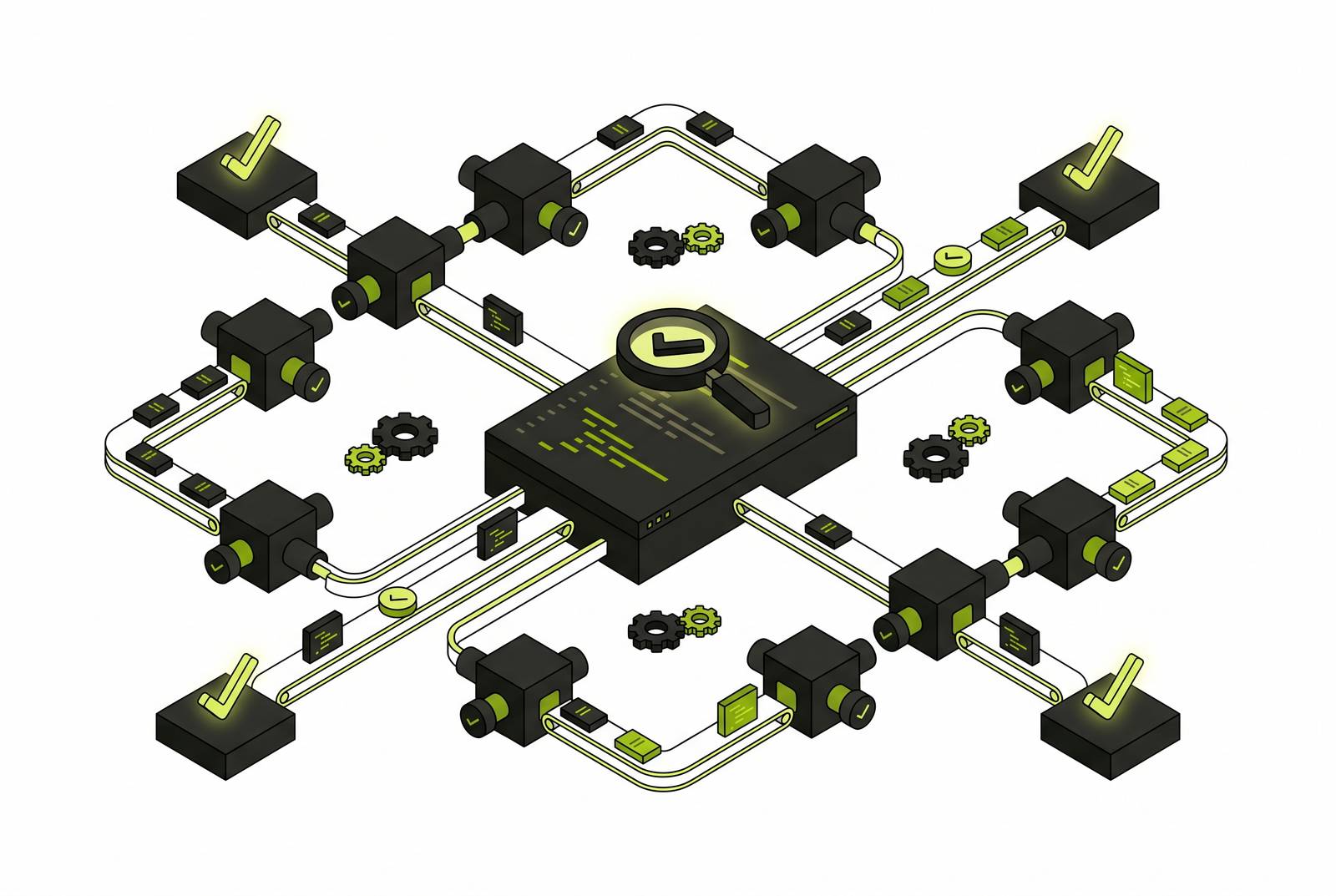
Automated code review tools for agentic pipelines must do more than comment on pull requests. They must keep risk in check as fast as agents produce code, without making review the bottleneck. What matters most is pipeline-native integration, repository-wide context, low false-positive noise, and review output that helps agents do better after the merge decision.
Why the volume of AI-authored PRs breaks traditional review pipelines
More code enters the review queue, but the capacity to review and integrate it does not rise at the same rate. Traditional pipelines are sized for human typing speed, with people absorbing the coordination work between authoring and merging. AI coding agents, including Devin, OpenAI Codex, Copilot, and Claude Code, now open PRs autonomously. That changes the rate at which work arrives without removing the judgment each change requires. The mismatch exposes a design assumption as well as a need for more review capacity.
Kamalı et al., June 2026 document this asymmetry in the wider workflow. AI coding assistants accelerate individual coding tasks by more than half, but coordination time for integration grows faster than individual output. AI-generated contributions also require more review iterations than human-written ones, so faster authoring adds both incoming work and repeat work. The Opsera 2026 benchmark found that AI-generated pull requests wait 4.6× longer to be picked up for review than human-written PRs.
When AI helps with review rather than authoring, reviewers find more low-severity issues but no more high-severity defects. More findings can therefore increase the work of review without extending its coverage of the hardest problems. The queue is constrained by attention as well as processing speed. A pipeline can become more active while remaining poorly equipped to assess the changes that matter most.
What AI-authored code actually looks like as review input, and why it stresses existing tooling differently
Selvanayagam and Ghaleb, ESEM 2026 constructed a dataset of AI-attributed PRs that received at least one AI-attributed review. They found that cross-product AI-to-AI review grew by more than two orders of magnitude from 2025-Q1 to 2025-Q3. Median time from PR creation to first AI review was 1.2 minutes for cross-product pairs. Review input is therefore no longer necessarily code submitted by a person and discussed at a human pace. It can be one agent’s output entering another agent’s review process almost immediately.
Within that process, the author–reviewer pairing affects the feedback. Claude Code PRs receive materially more refactor comments from CodeRabbit than Copilot PRs, although the difference may stem from the PRs themselves. Same-product AI reviewers also posted more comments per PR than cross-product reviewers, with the difference concentrated in the upper tail. The number of comments alone says little about how good the review is. The output reflects the reviewer, the pairing, and the contribution.
The code also carries a distinct risk profile. The Opsera 2026 benchmark found that AI-generated code contains measurably more security vulnerabilities per line than human-written code. That makes the distinction between fast feedback and useful defect detection consequential. Zhong et al. frame the wider change as a move from primarily human review toward AI-supported processes. Tools built around a human author interpreting isolated diff comments now operate within a closed loop whose pace, participants, and risks differ from that original design.
The three failure modes of review tools not built for agentic pipelines
The first failure mode is diff-only blindness. A reviewer limited to the diff cannot detect that a changed function has callers in three other services or violates an API contract defined elsewhere in the repository. It can miss cross-file regressions, effects on dependencies, and architectural drift. When an agent changes more than one file, it may leave inconsistencies that are visible only in the repository graph. Review can miss these problems even when it checks every changed line.
The second failure mode is noise that trains engineers to ignore the reviewer. At agentic volumes, more PRs bring more comments, so finding a useful warning takes more work. The Qodo 2025 State of AI Code Quality report says that roughly two-thirds of developers say AI assistants miss context they need. A context-blind reviewer can amplify that gap. The consequence is not merely an untidy discussion but reduced attention to the findings that need human judgment.
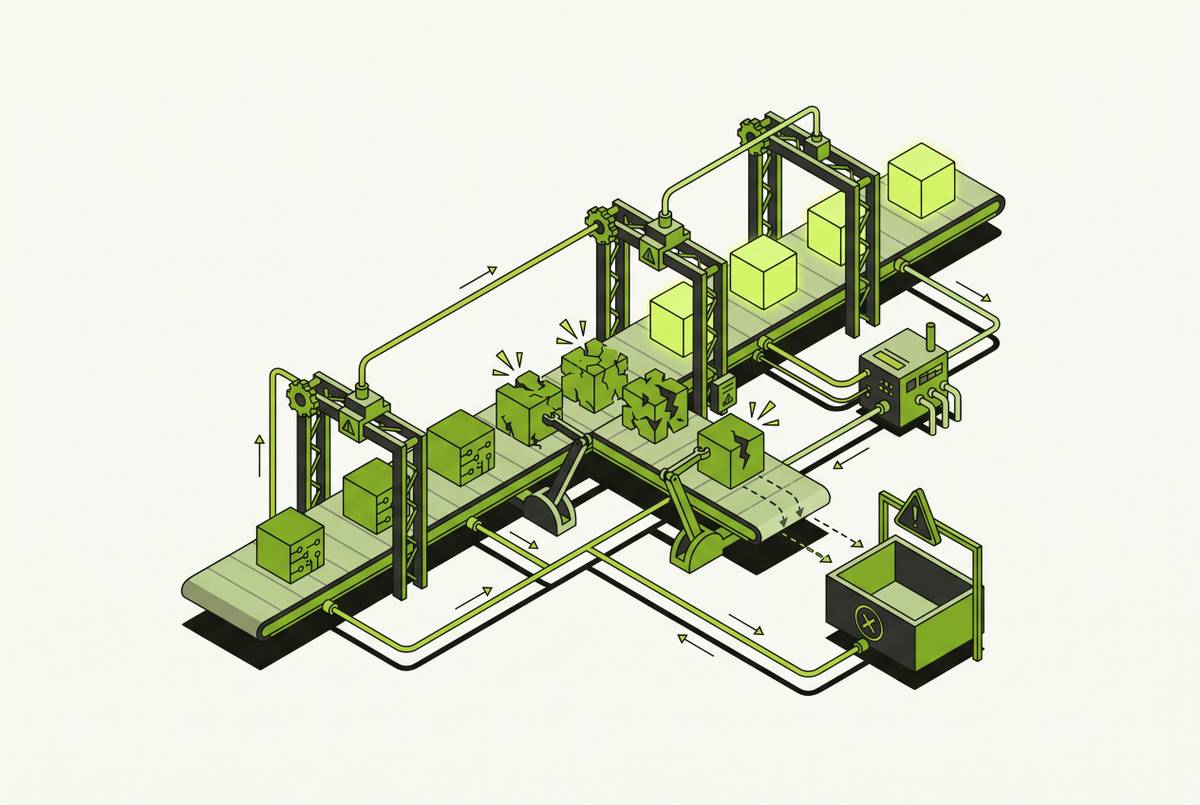
The third failure mode is blocking without distinguishing risk. Kamalı et al. frame review as the primary control surface for the quality and accountability of AI-produced code. A tool weakens that control when it gives low-risk changes, genuine defects, and flaky signals the same weight as reasons to stop work. It spends review capacity without discriminating between the changes that warrant it and those that do not. At high volume, the gate becomes a throughput wall.
These failures share a boundary problem. Diff-only review stops at the changed lines, noisy review leaves prioritization to the reader, and indiscriminate blocking stops at a pass-or-fail result. Each design assumes that a person can supply the missing context or coordination. Agentic pipelines expose the cost of that assumption because the work arrives faster than people can absorb it.
The criteria that actually matter when selecting review tooling for agentic pipelines
Pipeline-native integration is the first criterion. A tool that posts a summary comment on a PR is an overlay, while a tool that participates in CI gating, merge queue decisions, and agent feedback loops operates within the pipeline. The relevant distinction concerns the tool’s influence. Integration should reach the places developers already work, including GitHub, GitLab, CI/CD pipelines, and IDEs. Otherwise, the workflow still depends on separate handoffs to turn review findings into decisions.
SonarQube illustrates how that integration can support predictable gates. It provides consistent, repeatable analysis on every change regardless of who wrote the code. Its dedicated quality profiles and quality gates, including 'Sonar way for agentic AI', are calibrated for agent-generated code when projects are labelled accordingly. The selection question is whether review policy can operate at pipeline depth rather than remain advice attached to a PR.
Repository-wide context is the next criterion because useful review must assess relationships beyond the diff. Greptile scans whole repositories to check architecture requirements and cross-file changes, which helps it address dependency breaks and architectural drift. CodeRabbit uses a multi-stage agentic pipeline with repository-wide context to analyze merge requests and generate pull request summaries. The underlying test is whether the reviewer can evaluate the dependencies and contracts a change touches.
Noise control must be treated as a design constraint. Confidence thresholds, deduplication against review history, and suppression of comments on untouched lines help keep feedback focused. Greptile exposes configurable strictness, while CodeRabbit carries “Learnings” between reviews. Those controls matter because people have only so much attention to give, even when automated review is fast.
Deterministic gates and probabilistic AI feedback serve different purposes within that design. Static analyzers, including SonarQube, Semgrep, and the open-source linter family, produce repeatable findings for a fixed analyzer version and rule configuration. That repeatability makes them usable as compliance gates, while AI review can provide earlier and more contextual feedback before merge. In May 2026, Sonar acquired Gitar, combining AI-native PR validation with its multilayered, zero-trust verification platform. The combination illustrates the direction toward verification that is both deterministic and agentic, retaining auditability alongside broader reasoning.
Tiered autonomy is the last criterion, matching how closely code is reviewed to how much risk it carries. Low-risk changes, including dependency bumps, documentation, and test additions, can flow to full auto-merge. Logic changes and new features need agent review and human approval, while schema changes, auth, and payment logic need human-only review by more than one reviewer. A tool unable to participate in that routing forces every change through the most expensive path. Kamalı et al. propose a five-stage framework comprising PR Creation, PR Augmentation, Reviewer Selection, AI-Assisted Code Review, and PR Retrospective, retaining humans at selected key decision points.
How review tooling must connect to the merge queue, not just the PR
Tiered autonomy only works if the chosen review path is tied to the rules for when code can merge. The merge queue must catch integration conflicts between PRs that each pass on their own. Two AI-generated PRs can still combine into a broken main even when each tests cleanly in isolation. A review tool that stops at the PR boundary leaves this integration problem to a separate system. The decision to accept an individual change is therefore not the same as proof that it can land safely with other changes.
Batch failures make that distinction operationally expensive. A naive queue ejects the whole failed batch and retests everything, while a queue that bisects can find the culprit with O(log n) full CI runs. One red test invalidates the speculative state against which every PR behind it was tested. The flaky-test rate, along with code quality, sets the frequency of this cascade. False-positive review signals can also block work needlessly in a pipeline where unstable tests already do so.
Talyn triages every PR worst-first, then sends an AI agent to fix failing CI, merge conflicts, and review comments before merging automatically when the PR has been opted into the merge queue. SVRF is described as “The merge queue built for AI agent swarms, batches, bisects, and proves every landing”. Both examples illustrate an architecture that connects validation to the work of landing changes rather than treating review and queue maintenance as unrelated stages.
Testing capacity must support that architecture as well. When every queue entry has its own full-stack isolated environment, it can run without waiting for another entry’s environment to become free. Warp reports that its engineering team currently automates roughly a third or fewer of its PRs through factories. An agentic merge queue can handle conflicts, CI failures, and queue management while reserving human intervention for meaningful decisions. At that point, review tooling and merge infrastructure become parts of the same control system.
Using review output as a signal source for improving agent behavior, not just gatekeeping merges
What the reviewer flagged, what the agent fixed, and which errors recur can inform agent configuration. Selvanayagam and Ghaleb found that CodeRabbit posts refactor comments on 35.0% of Claude Code PRs. Because that difference may stem from the PRs themselves, it warrants investigation before drawing conclusions about either product. Per-agent patterns are more useful for tuning than an undifferentiated total of review comments.
That tuning includes adding, removing, or retuning skills. Bloated agent skill sets hurt performance, and repeated error classes can indicate that a skill is being invoked incorrectly or producing low-quality output. Agent Transcript Analysis surfaces how AI coding agents use their skills across the PR lifecycle. It gives teams a basis for trimming dead weight and adjusting agent harnesses against what review consistently catches. Kamalı et al.’s PR Retrospective stage also treats review context as useful after the decision to merge a change.
Deterministic code should first produce the raw facts, including the files and functions and the lines the change touched, without judgment. The agent can then reason over those facts, with every claim matched back against them. This discipline separates what the authoring agent did from how the reviewer characterized it. Without that distinction, configuration changes risk responding to the reviewer’s description independently of the underlying contribution.
Exceptions, query issues, and deploy failures can flow back into review tooling so that similar changes by the same agent are not assessed without context. A reviewer aware of those outcomes can weight its findings accordingly. The purpose of automated review is then broader than stopping defective code. It becomes a pipeline signal that directs human judgment, supports integration, and improves the agents producing the next change.