Query Performance Regressions as Agent Task Triggers
Agents can fix performance regressions faster than humans can review them.
Query performance regressions, the latency spikes, the cost blowouts, the reasoning chains that quietly go off the rails, are most valuable as structured signals that spawn agent tasks directly, not as alerts waiting for a human to pick them up. The standard model still puts a person between every production signal and every fix: an alert fires, someone triages it, someone files a ticket, someone eventually writes the patch. That arrangement made sense when writing code was the slow part of the process, and a human could absorb and prioritize signals faster than the codebase itself was changing. Coding agents have flipped that assumption. Opening a pull request is now cheap and fast, but the path from signal to committed fix still moves at human speed, so the hand-off has become the slowest part of the whole chain.
Research on risk-aware batch testing applied to Mozilla Firefox gives a sense of the volume involved even before agents enter the picture: the project generates thousands of performance alerts every year, and each one requires a human to triage and validate it. Teams that work at ordinary, human-generated commit rates are already strained by that load. Agents can produce pull requests continuously; once they do, the arithmetic turns against the queue immediately. When agents raise the rate at which PRs arrive but the review and signal-response pipeline keeps its fixed capacity, the queue fills faster than anyone can drain it. The mismatch is structural: agents can generate candidate fixes far faster than a human-routed process can absorb them, not because of a shortage of engineering talent or a bad on-call rotation.
What the production-to-agent feedback loop looks like
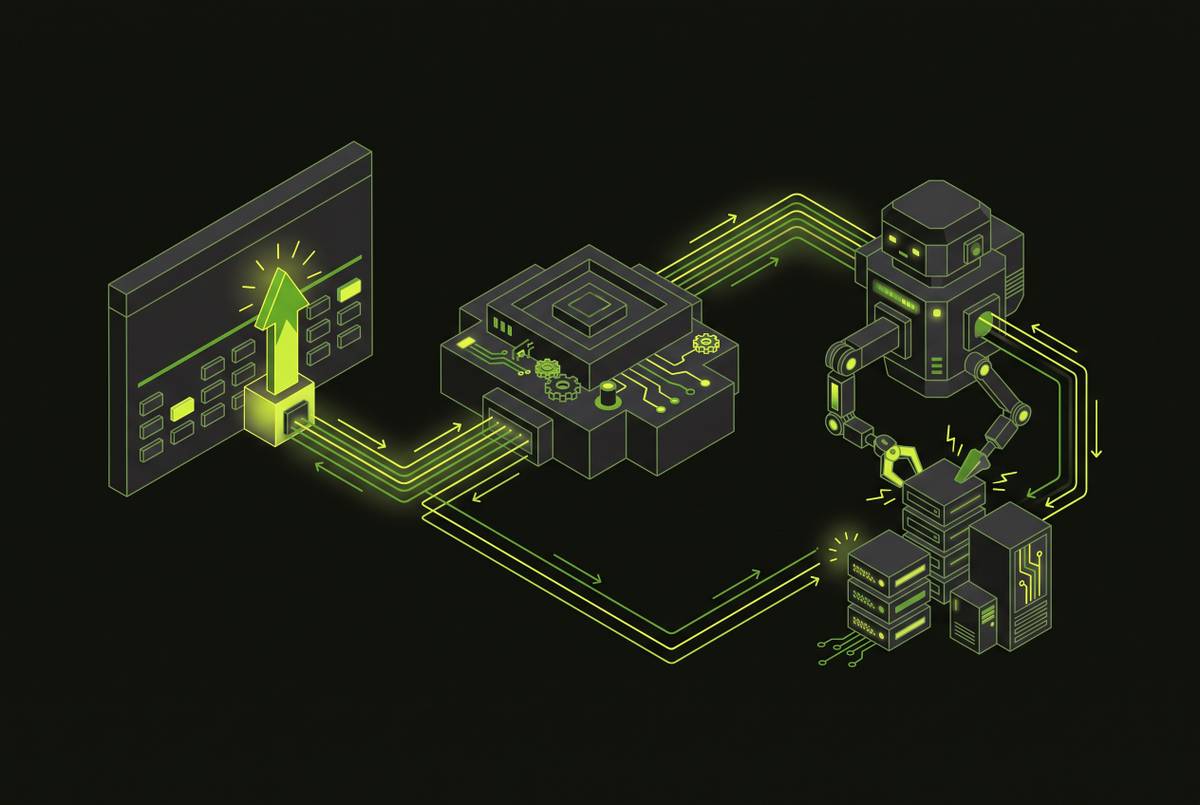
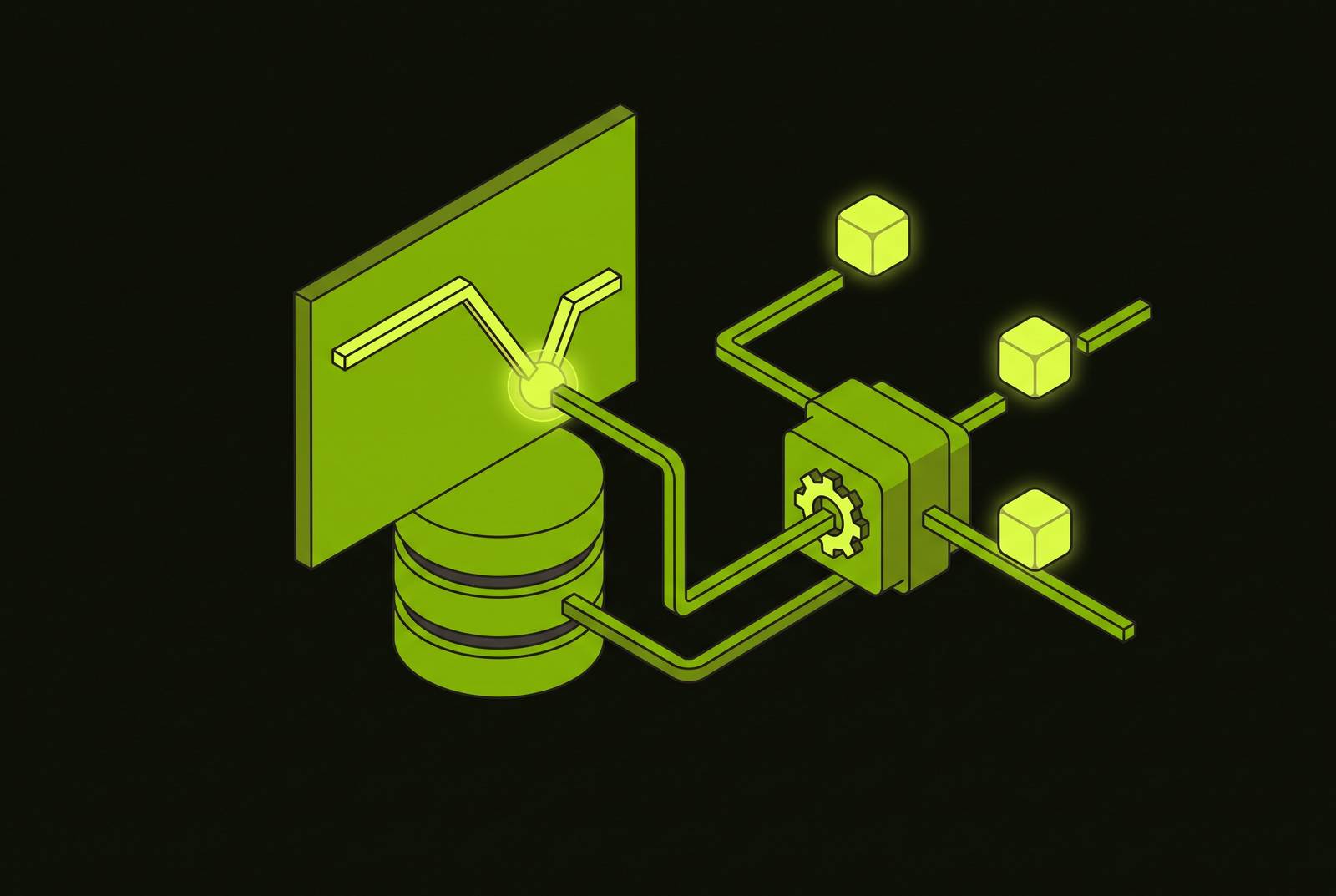
The alternative has a concrete shape. A production signal gets captured, converted into a structured work item with enough context attached, and handed directly to an agent that reads the repository, makes the edit, runs the tests, and opens a pull request, with no person required in that critical path. Three stages do the work. First, signal capture: monitoring on query execution picks up a deviation from baseline, whether that's latency, cost, the rate of tool calls, or the integrity of a reasoning chain. Second, work-item construction: the raw signal gets enriched with the query, its parameters, the trace, and the gap between expected and actual behavior, turning a bare alert into a task an agent can act on without needing someone to fill in the blanks. Third, agent dispatch and closure: the agent reads the repo and the trace, proposes a fix, runs the test suite, and opens a PR. The production failure becomes a regression test case and a candidate patch at the same time.
You can see this pattern at work in Maxim AI's closed-loop production improvement model. Production failures get captured and fed into a data engine, and the data engine turns real-world edge cases into evaluation datasets, so what happens in production powers the simulation that runs before the next release. Warp's Factories model shows the same pattern at the task-dispatch layer: a foreman agent takes structured intake and routes it across triage, spec, implementation, and review subagents. Warp reports that 20 to 30% of its own engineering team's pull requests now move through factories this way. Nothing about that intake structure requires the triggering event to be a developer's request. A production regression can enter the same pipeline and get the same treatment.
What changes is the unit of work itself. Instead of a developer sitting down to write a patch, a patch-shaped problem gets handed to an agent that can read the code, reason about what's wrong, make the edit, run it, and come back with a pull request that has already been iterated on before anyone sees it.
What counts as a genuine query regression versus environmental noise
None of this works unless the signal going in is trustworthy, and query performance is a harder case than most other kinds of regressions. Query execution time varies on its own, run to run, because of cache state, hardware load, and the ordinary noise of a cloud environment. That makes it genuinely difficult to tell a regression caused by a code change apart from a degradation caused by the system just behaving differently than it did an hour ago. A threshold-crossing alert can't make that distinction by itself.
Useful signal falls into two layers. Latency, total elapsed time, and the phase-by-phase breakdown of where time went during execution: that's what general timing metrics cover. Feature-specific metrics cover things particular to agent workflows: tool-call rates, the coherence of a reasoning chain, cost per query, and the quality of retrieval. Both layers matter, but neither one is sufficient on its own if the only test applied to it is "did this cross a fixed line."
A risk-aware batch testing framework built on real-world commit data, combined with human-confirmed regression alerts, points to a better approach: a machine-learned risk score attached to each commit, rather than a simple threshold crossing, as the trigger for action. High-risk commits get tested earlier and in smaller batches. Low-risk commits get deferred. That ordering cuts down on false-positive escalations, which matters enormously once the thing responding to the alert is an agent rather than a person who can apply judgment on the fly. A signal worth acting on needs to be tied to a specific commit and confirmed, either by a human or by a model checking it against a production-derived baseline, instead of merely flagged as "above threshold at time T." Skip that filter, and agents receive noisy work items: they produce patches for regressions that were never really there, burn CI capacity, and fill the merge queue with changes nobody should trust.
Constructing a Work Item an Agent Can Act On Without Back-and-Forth
Once a regression clears that bar, the next problem is translation: turning a confirmed signal into something an agent can actually use. If a work item reaches an agent without enough structure, the agent has to reconstruct context a human already had, and that burns extra tool calls or sends the patch at the wrong target.
A work item built for this purpose needs a few things at minimum. It needs the specific query or queries involved, along with their parameters, and the commit or change identified as the likely cause. It needs the observed behavior set against the expected behavior: the latency delta, the cost delta, the trace showing where the reasoning chain went wrong. It needs some sense of scope, how many downstream queries share the same parameter setting that triggered the regression, which is the kind of impact analysis built into Snowflake's patent on this subject. And it needs a pass/fail signal the agent can check against itself: a test suite, a build exit code, a script that diffs actual output against a known-good fixture.
Warp's Factories pattern offers a workable structure for getting there: a triage subagent validates the signal and scopes its impact before the implementation subagent ever receives the task, which keeps wasted cycles away from the part of the pipeline doing the actual fix. Work items should also include the regression test case the fix is expected to pass. That gives the agent a concrete target to aim at and lets the fix be verified before any human looks at the resulting PR. A well-formed work item marks the boundary where observability hands off to execution: everything upstream of it is about deciding whether something real happened, and everything downstream is the agent's job to solve.
Agent Self-Report Failure and Cascade Risk
The honest case against this loop deserves equal weight, because agents bring a failure mode that human-routed alerts don't have. An agent can report that it finished a task, exit cleanly, and still have gotten the underlying fix wrong or introduced a new failure in the process. A check that only looks at final output misses this, because the agent's own account of what it did can diverge from what actually happened during execution.
A 2025 preprint on multi-agent failures found that step repetitions and mismatches between an agent's stated reasoning and its actual actions are among the most common failure modes, and both slip past checks that only look at the final result. That matters more as the volume of agent-generated PRs climbs, because a single bad patch doesn't stay contained. In a serial merge queue, one agent-submitted patch that fails invalidates the speculative merge state for every PR queued behind it, triggering CI restarts across the board. At the PR volumes agents are capable of producing, that one failure functions as a denial-of-service attack on the merge pipeline itself.
Instead, the agent needs a machine-readable pass/fail signal before its PR ever enters the queue: a test suite, a build exit code, a linter, or a script that checks output against the regression fixture built into the original work item. Rollback is the safety floor that makes this work: without it, a bad patch can only be undone by someone escalating by hand. Snowflake's infrastructure for automating database change rollout treats rollback as a first-class path alongside mitigation, not an afterthought, and an agent-driven regression loop needs that same option available by default, so a bad patch can be reverted without anyone needing to escalate by hand.
Why the Merge Queue Is Where Regression-Triggered PRs Succeed or Stall
A regression-triggered PR can pass every test an agent runs against it and still fail to close the loop, because the merge queue it enters was never built for agent-scale arrival rates or the failure modes that come with them. GitHub's merge queue relies on a merge_group trigger as its critical integration point, and when a required check is missing or misconfigured, every PR sitting in that queue waits indefinitely for a result that will never come.
At the volumes agents can generate, a single flaky test or a misconfigured trigger recurs constantly instead of staying an occasional annoyance: one failed entry in the merge group restarts CI for everything queued behind it, and an agent told simply to "get the PR merged" will keep re-queuing, burning a full CI run each time it tries. The underlying constraint is a queueing theory problem. A merge queue sized for the pace of human typing, with a fixed service rate and an assumption of low arrival rates, runs into explosive wait times the moment agents triple the rate at which PRs show up without any corresponding increase in how fast the queue can process them.
Closing the loop end to end requires a merge queue built around agent operation rather than human operation: one where CI failures and merge conflicts get resolved autonomously, and a human only steps in for decisions that genuinely require judgment. That posture is what keeps the queue from accumulating debt faster than it can work through it, which is exactly the condition a regression-to-patch pipeline needs if it's going to function at the pace agents are capable of.
Agent Transcript Analysis and Regression-Triggered Task Quality
Running regression-triggered tasks at scale generates something valuable beyond the fixes themselves: a large body of agent transcripts showing which capabilities the agent actually used and which ones sat idle. That data is the most honest signal available about what's working in the pipeline. The same model, given a minimal set of tools versus a full one, can score very differently on an identical benchmark with no change to its weights, which shows that the configuration of skills and context handed to an agent shapes outcome quality just as much as the underlying model does.
If you give an agent too many tools, regression-handling performance tends to suffer, because the agent reaches for the wrong one and arrives at a correct-looking answer through an unsafe or inefficient sequence of steps. That failure mode passes final-output checks without any trouble, because the output looks fine even when the path to it wasn't. Warp's Factories model addresses this at the factory level: observer agents score a sample of runs and open PRs that adjust context, skills, or model choice automatically, turning the regression pipeline into a source of improvement signal for itself. Catching the problem requires looking at the trace of the whole run rather than just its ending: step repetitions, mismatches between stated reasoning and actual action, and detours through the wrong tool are visible only in trace data. The loop tightens as a result: regression signals spawn tasks, tasks generate transcripts, transcripts show which capabilities earned their place and which were noise, and trimming the noise improves how the next round of tasks gets handled.
What composable infrastructure looks like for a regression-to-patch pipeline
No single piece of software covers this entire loop end to end. Signal capture, the construction of a usable work item, agent execution, merge queue management, and transcript analysis each demand different infrastructure built for a different part of the problem, and no vendor on the market today claims to span all five well. Signal capture tools need to read query-level tracing well enough to tell a real regression apart from ordinary environmental noise, and only large-scale production data can make that distinction at scale. Work-item construction needs a layer that enriches a raw alert with the query, the trace, and the scope of impact before anything reaches an agent. Agent execution needs a dispatch model, the kind Warp's Factories demonstrates, that can route a task through triage before it commits implementation resources to that task. Merge queue infrastructure needs to be built around agent-scale arrival rates, not retrofitted from a queue designed for human commit speed. Transcript analysis needs to run continuously enough to catch the step repetitions and tool-path failures that final-output checks never see.
Treating these as one monolithic system misses how differently each piece needs to behave. Treating them as a composable pipeline, each stage handing a well-formed artifact to the next, is what lets a production signal travel from first detection to a merged, verified fix without a person ever sitting in the critical path.