Routing Production Exceptions Directly Into Agent Coding Workflows
Agents need production failures routed back into their coding loops.
AI coding agents write, test, and ship code, but they never learn what happens to it once it runs. The industry has spent 2025 and 2026 moving engineers from writing every line themselves to orchestrating systems of agents that plan, edit, test, and open pull requests on their own. That loop looks complete from the inside: an agent pulls context, makes a change, watches the test output, and adjusts until the checks pass. The loop stops at the edge of continuous integration. Nothing built into it tells the agent what the code actually did once it reached production. A test suite going green and a service staying healthy under real traffic are different outcomes, and the current architecture only reports on the first one. Fixing that is less a matter of making agents smarter than of giving them a signal they currently never receive.
The production failure rate that makes the gap a crisis
The absence of a feedback channel turns into measurable damage once code actually ships. Lightrun's 2026 State of AI-Powered Engineering Report draws on senior SRE and DevOps leaders, and it found that a substantial share of AI-generated code changes still need manual debugging in production after they've already cleared QA and staging. Passing every pre-deploy gate, in other words, says less about production safety than teams would like it to.
The n8n incident from February 2026 shows what that looks like in practice. After the upgrade from v2.4.7 to v2.6.3, users found that the Vector Store Question Answer Tool had started generating invalid JSON schemas for function calling. OpenAI rejected the malformed calls with schema errors; Anthropic rejected them over a missing required field, input_schema.type: Field required. No pre-deploy test caught the break, and a deployed agentic workflow went fully offline as a result. The failure traced back to a brittle connector, the kind of integration surface that only exists once a system is wired into other live systems.
Staging environments cannot reproduce the distributed state or the production traffic patterns that expose failures like this one. A class of bugs stays structurally invisible until deploy, no matter how thorough the test suite is beforehand. An SRE watching the n8n failure unfold had, within minutes, a stack trace, a service name, and a correlation to a specific version bump. The agent that authored the original change had none of that. Closing the gap between what the SRE sees and what the agent can act on is the problem the rest of this piece works through.
What "closing the loop" means architecturally
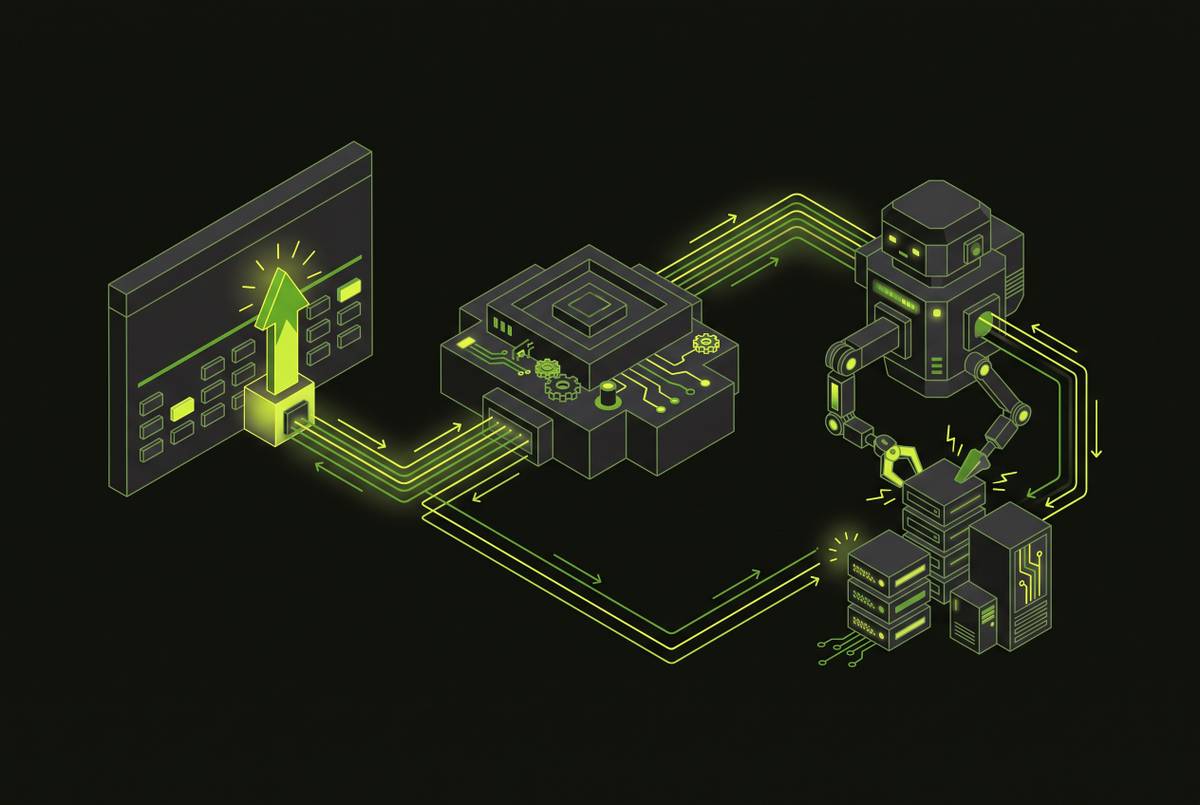
Wiring production signal into an agent's workflow is a new data path that demands decisions about what gets captured, how it's shaped before it reaches the agent, and where in the agent's loop it gets introduced.
The agent loop already has a defined point where it checks its own work: after acting, it reads test output and CI logs and iterates based on what it finds. That step currently ends at the CI boundary. If you extend it, you treat production as another signal source feeding the same channel, rather than building a separate, parallel system the agent has to be taught to check.
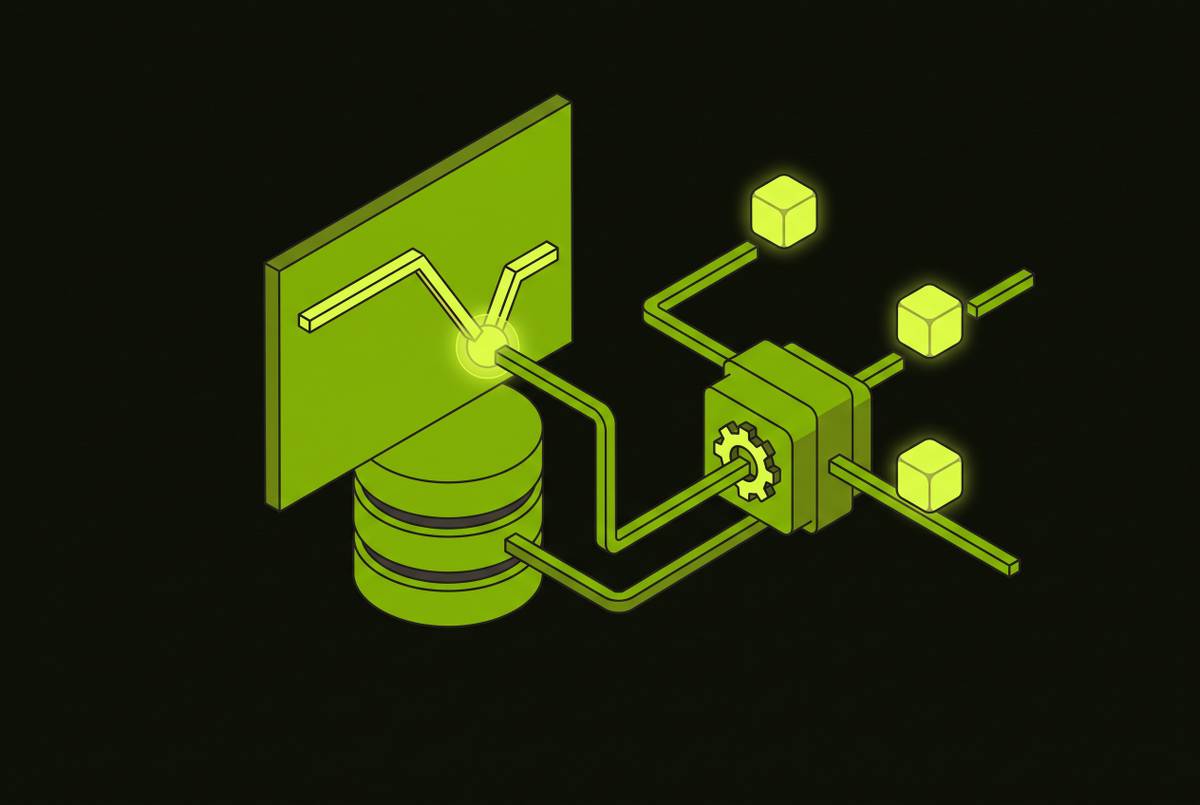
An agent doesn't need a raw log dump: it needs the exception trace, a correlation ID where one exists, the affected service's context, and enough surrounding state to describe the failure as something reproducible. A log dump asks the agent to do forensic work it isn't well suited to doing cold, but a structured, correlated failure description gives it something closer to a bug report a human engineer would actually act on.
Before any of that can reach an agent consistently, it needs a common shape. Different coding harnesses produce different transcript formats, and different observability stacks produce different exception formats, so normalization becomes a prerequisite rather than a nice-to-have. Letta's trajectory library, released in July 2026, normalizes native session transcripts from 15 harnesses, including Claude Code, Codex, Cursor, Gemini CLI, and OpenHands, into one validated, model-ready record format. That same normalization layer is what makes feeding production exception traces back into an agent's loop tractable rather than a one-off integration for every tool combination.
Where the signal lands in the loop also changes how the agent treats it. Injecting a production exception as a new, discrete task, with its own stop condition of tests passing and the failure not recurring, gives the agent a bounded problem to solve. Dropping the same exception into an existing session as an interrupt gives it something closer to a distraction. Harnesses already mediate between a model and its environment through tools, context management, control flow, and persistent state, and a production exception path is just one more tool call inside that mediation layer. That means it can carry the same idempotency and timeout contracts any other tool call carries, rather than needing an entirely new category of agent behavior.
One more separation matters here: a transcript claiming an operation succeeded is not the same thing as the operation having succeeded. The same caution applies to exception handling. An agent should read current production state from its authoritative source before acting on a fix, rather than from a cached or summarized version sitting in its prompt.
Why merge queues become load-bearing under agentic volume
None of this works if the pipeline the fix has to pass through is already buckling, and agentic volume is a major cause of that buckling. An agent told to get a pull request merged will simply try again when it fails, re-queuing the same change and burning a full CI run on each attempt. A retry pattern that was mildly wasteful at human speed turns into something close to a denial-of-service attack on the pipeline once an agent is doing the retrying.
Uber's experience with flaky tests shows what that kind of strain looks like even without agents amplifying it: before the company built dedicated flake management, its iOS mainline was green only about half the time, with a large number of flaky tests turning up across hundreds of thousands of runs. An agent that reflexively resubmits on failure turns that kind of flake rate from an annoyance into something that consumes the pipeline's entire capacity.
Traditional CI, where tests run after a change merges, assumes a human reviewer who knows the codebase well enough to catch what the tests miss. Agents don't carry that implicit knowledge, so they constantly regress areas nothing is watching, and a post-merge CI failure appears only after the agent's context window that produced the change is already gone. There's no one left to interpret the failure in light of the original intent.
The fix taking hold across the industry is to run all tests before a change reaches the default branch, inside a merge queue, and give agents access to that same pre-merge check minus the actual merge step, so they catch and fix failures before anyone else inherits them. GitHub validated a merge queue across 4.5 million CI runs before general availability, against thousands of monthly pull requests landing in a single monorepo. At that volume, the merge queue isn't a convenience feature; it's the only thing standing between the pipeline and collapse.
For exception-driven fixes specifically, the merge queue is what makes the whole loop trustworthy. The agent picks up the production signal, writes a fix, and queues it like any other change, subject to the same pre-merge gate everyone else's code goes through, with no special path and no bypass.
The governance boundaries that must hold when agents handle production exceptions autonomously
A closed feedback loop gives an agent visibility into production failures. It does not, and should not, give that agent the authority to merge its own fixes unsupervised. The constraints that already apply to agentic code changes apply with more force once the trigger is a live production failure, because the cost of a wrong fix lands on a system already in distress.
A handful of boundaries hold regardless of how much autonomy a team is willing to grant elsewhere. Agents should not bypass branch protection or rulesets. They should not self-approve a pull request they authored or co-authored. They should not merge directly to the default branch outside a queue. They should not read or write secrets a workflow doesn't need. And they should not be the sole reviewer on code touching authentication, payments, secrets, infrastructure, schema migrations, deletion paths, or regulated data.
The broader architecture taking shape across the industry in 2026 runs on a maturity model: manual review is at one end, and bounded autonomous merge lanes, built on policy-as-code, merge queues, canary checks, observability, auto-revert, and signed provenance, are at the other. Even at the autonomous end, policy alone decides the merge, and only inside change classes that have been pre-approved as low blast radius. Exception-driven fixes need to be classified against that same model before any automation touches them. A stack trace from a payments service and a stack trace from a logging utility are not the same event, and they have no business sharing an autonomous lane.
That caution is not theoretical. Research from Zhou et al., "AgentS4D: Benchmarking Runtime Risks across the Execution Lifecycle of LLM-Based Workspace Agents," found that across thousands of runs, a majority were both unsafe under a prespecified safety signal and complete. Task completion and safety do not move together: an agent that successfully authors and merges a fix has not thereby authored a safe one.
Governance doesn't have to mean a human sitting in the loop for every decision. The Warp Factories control plane, as of September 2026, shows a workable alternative: observer agents score a share of completed runs and open pull requests that adjust prompts, skills, model choice, or context, while factories themselves are defined as version-controlled code so a workflow can be rolled back. Governance there is automated and auditable in its own right, without a queue of approvals waiting on a human. That's the model that makes a closed production-to-agent loop something a team can trust rather than something it has to babysit.
The strongest objection: agents can produce plausible patches that miss the actual root cause
The real danger in a closed feedback loop is an agent that does something confidently wrong, producing a patch that clears every test while leaving the actual cause of the failure untouched, because that cause lives in distributed state the agent never had access to.
Tool-calling itself fails at a rate of 3 to 15 percent in production. The most damaging failures in that range are silent ones, where a tool returns a success code attached to an empty payload. An agent in that situation may have no way of knowing its own context retrieval failed. It can then build a fix on top of data it never actually received.
Compounding that, LLM-based agents are probabilistic by construction. The same prompt can produce different tool selections, different reasoning paths, and different final outputs if you run it separately. A failure that appears in production may simply not reproduce in the test environment the agent uses to validate its own fix, the same environment the agent has no choice but to trust.
Distributed systems compound the problem further. Agents struggle with race conditions that span multiple microservices. They can gather and format logs quickly, but what they're looking at is a single-service slice of a failure that may have originated somewhere else. The stack trace an agent receives can be a symptom of the real problem rather than the problem itself.
None of that argues for abandoning the loop. It argues for constraining what an agent is authorized to do with what the loop gives it. Automated fixes should be scoped to change classes where the root cause is reliably locatable from the exception trace alone: single-service logic errors, schema mismatches, dependency version failures, the kind of brittle-connector break that hit n8n. If failures span multiple services or depend on shared state, they should route to the agent for triage and log formatting only, and a human has to sign off before the fix enters the merge queue. And any autonomous merge in the exception lane should require canary deployment and auto-revert as a standing condition, so a plausible-but-wrong patch reverts itself before it compounds the original failure.
The governance model from the previous section and this constraint work together. Bounded autonomous lanes paired with canary-and-revert don't make a wrong patch impossible. They make its blast radius something a team can absorb rather than something that takes a system down twice.
Infrastructure decisions for building the feedback path in practice
Everything above resolves into four infrastructure decisions a team actually has to make: what triggers the loop, how the signal gets normalized, where durable state lives, and how the merge gate enforces the blast-radius limits already described.
The trigger should be deterministic and structured: a classified exception event carrying a correlation ID, the affected service, and a severity tier, rather than a raw stream of logs handed to the agent to sort through. Confidence scoring on that incoming signal catches the ambiguous cases and routes them to a human instead of letting them proceed silently into an agent that may misread them.
Normalization has to happen before a production trace and an agent's session transcript can speak the same language. The same pattern behind Letta's trajectory library, built to normalize transcripts across 15 different harnesses into one validated record format, applies just as well to exception payloads: normalize the signal once, and every agent workflow downstream can consume it without a custom integration.
Durable state has to live outside the prompt. An agent needs to read current production state from its authoritative source before it acts, and any decision that needs to survive into a new session needs to be persisted somewhere real, not reconstructed from a transcript that claims a fix was already applied.
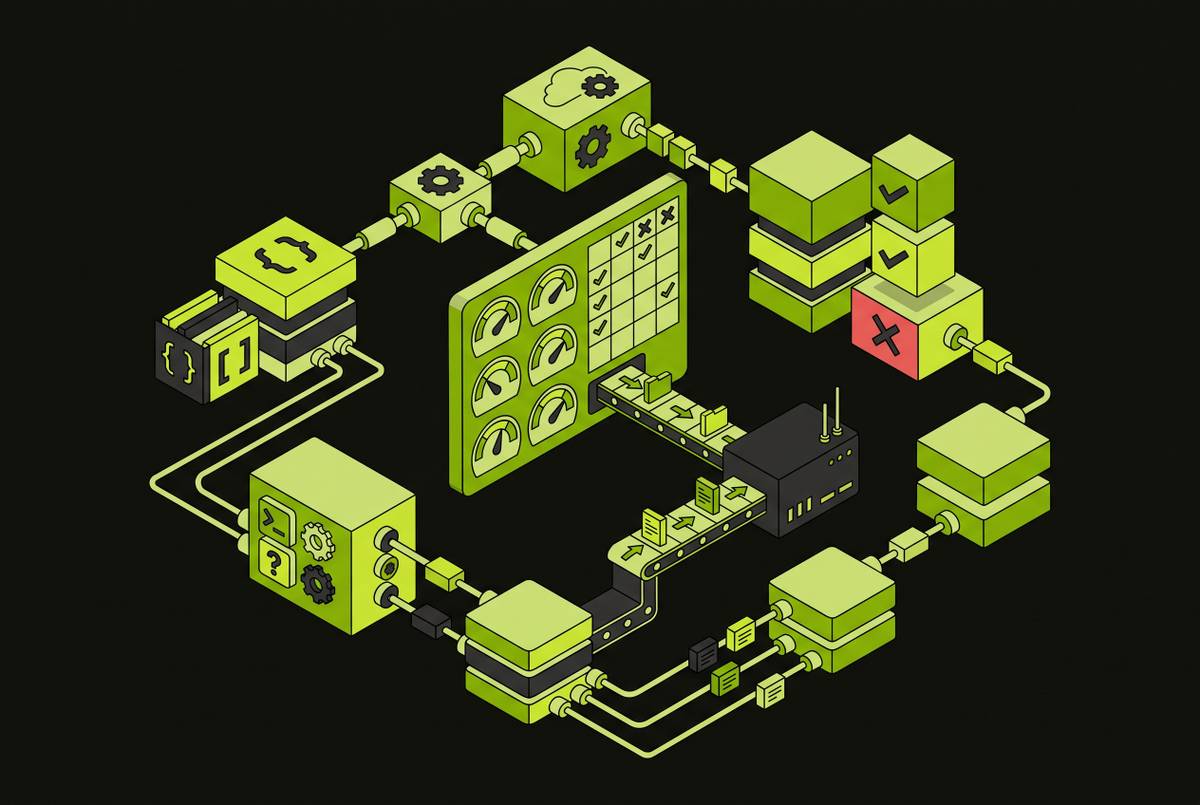
An exception-driven fix enters the same merge queue as any other change, runs the same pre-merge tests, and clears the same policy-as-code checks tied to its change class: autonomous merge if the fix is low-blast-radius, human sign-off if it touches shared state across services. Building the feedback path means building that full chain deliberately, signal in, normalized, read against real state, gated by the same queue everything else passes through, rather than hoping a smarter agent eventually closes the gap on its own.