SLO Breach Workflows That Feed AI Agent Remediation
Enriched breach signals and sandboxed validation enable agents to remediate SLOs safely.
SLO monitoring has gotten smarter without getting more useful to the systems that could actually act on it. The signal quality keeps improving while the plumbing that would let an agent respond to that signal has not kept pace, and that gap is the subject of this piece.
SLO breaches as the wrong unit of measure for automated remediation
The dominant model of SLO monitoring fails platform teams at the exact moment it should help them most: it reports what already went wrong instead of giving an agent something to act on. Threshold-based alerting works like a scorekeeper. Monday.com's 2026 analysis on the subject makes the mechanics plain: by the time a threshold alert fires, queues have already formed and the breach has already happened, so the alert only confirms a failure that has already occurred rather than enabling a response to it.
Teams that have lived with threshold alerting long enough tune out a large share of it, and the muscle memory built around ignoring noise doesn't switch off for the alerts that matter. Fixed thresholds have no sense of context.
A breach that stays inside a monitoring tool has no effect on anything downstream, because the noise described above obscures the fact that nothing connects the alert to a system that can act on it. It doesn't touch the pipeline that shipped the code responsible, and it doesn't reach any agent that might fix it. The dashboard knows something broke. Nothing connected to that dashboard knows what to do about it.
Self-learning thresholds, described in the same monday.com overview, start to close part of this gap by adjusting alert sensitivity for seasonality, deployment timing, and shifts in usage patterns. That's a real improvement in signal quality, cutting down the false-positive noise that erodes trust in alerting. But adaptive alerting on its own is not a remediation workflow. A smarter alert is still just an alert unless something downstream is built to receive it and act.
Making a breach signal genuinely triggerable by an AI agent
An SLO breach becomes something an agent can use only when it shows up as a structured, enriched event rather than a raw alert, carrying enough diagnostic context for the agent to reason about a fix without a person filling in the gaps. That's an engineering requirement, not an aspiration, and it changes what the monitoring layer has to produce.
GuardedAct, the remediation framework from Cai and colleagues, makes this requirement explicit in its own architecture. Its first phase ingests a diagnosis report together with live system topology and recent telemetry before it generates any remediation action at all. The model doesn't get to propose a fix until it has the context needed to understand what it's looking at. The structured input is what makes the rest of the pipeline trustworthy.
Lead time matters as much as context. Predictive analytics can flag a probable breach trajectory with an estimated probability before the formal threshold even crosses, so the agent gets a head start instead of a postmortem.
This fails if the data underneath it is inconsistent. Mismatched timestamps, incident histories split across disconnected systems, and missing service identifiers produce agent actions that look confident and are wrong. A trigger pipeline is only as reliable as the data feeding it, and that reliability has to be designed in before any agent touches the signal.
A 2026 practitioner framework separates computational controls, things like linters and tests that check code directly, from inferential controls, like using an LLM as a judge of quality, and argues that whether a system can actually be acted on by automation (its harnessability) should be a first-class concern in how these architectures get designed. Applied to SLO breaches, that means the signal pipeline has to be built for an agent to consume, not for a human to read on a dashboard. Those are different design problems, and conflating them is how teams end up with alerts that look good to an engineer and mean nothing to an agent.
The remediation loop: from breach detection through agent action to verified recovery
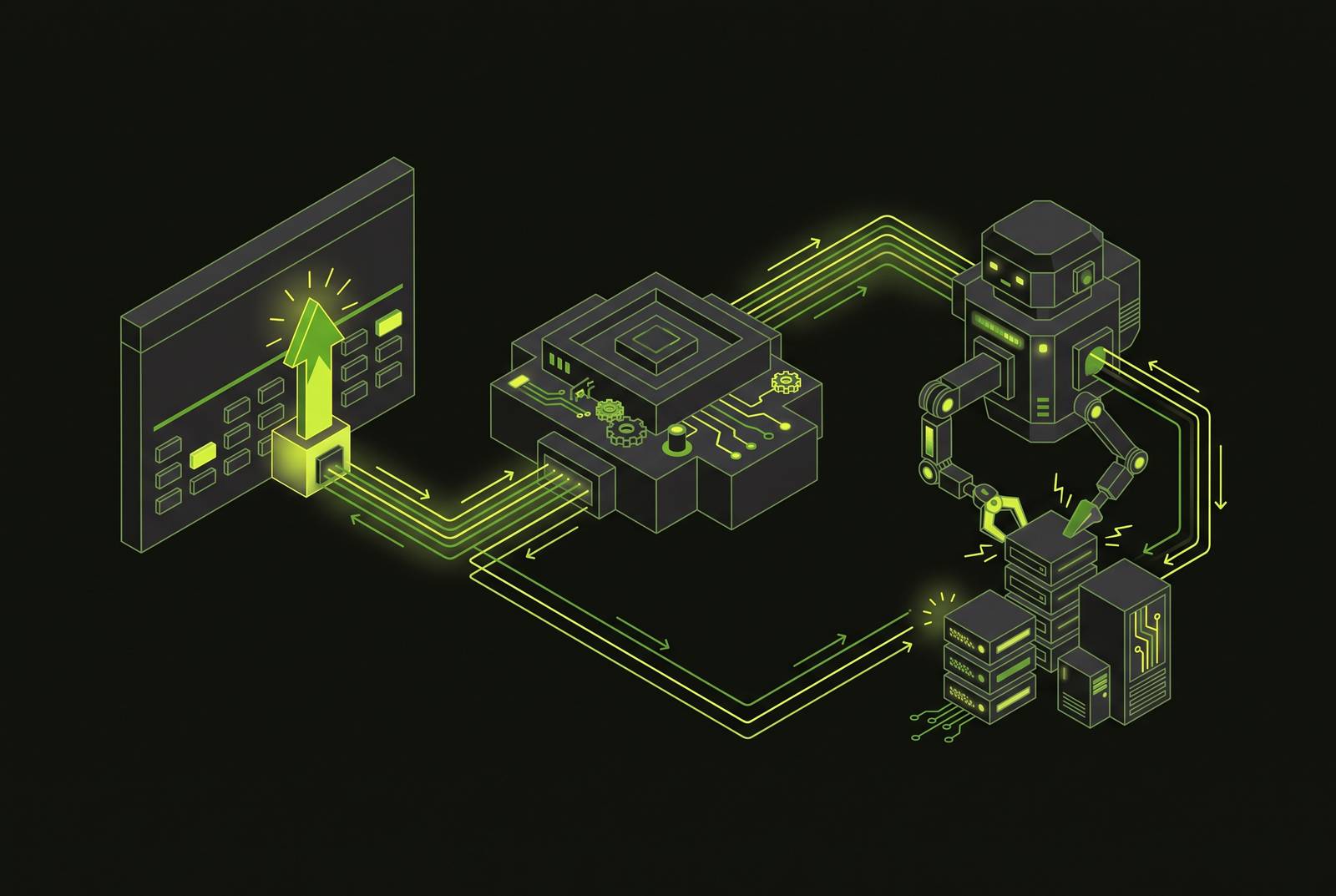
A remediation loop that holds up in production runs through four distinct phases: ingestion, candidate generation, sandboxed validation, and gated execution. Skipping or compressing any one of them is where autonomous remediation tends to go wrong once it's live.
Ingestion is the phase already described: the diagnosis report, the topology, and the telemetry arrive together, giving the agent a coherent picture of the failure rather than a fragment of one.
Candidate generation comes next, and this is where large language models have shown real, demonstrated ability. GuardedAct uses an LLM to turn that diagnosis report, topology, and telemetry into a ranked list of candidate remediation actions. The model proposes options ordered by its own confidence rather than committing to a single fix, which matters for everything that follows.
Sandboxed validation is the phase that keeps candidate generation from becoming a liability. Each candidate action runs first in a lightweight digital-twin sandbox, never in production. GuardedAct estimates the blast radius of each action using dependency-graph analysis and replayed telemetry, then assigns it a risk label. This step is not optional overhead bolted onto an otherwise fast pipeline. Executing LLM-generated actions directly in production, without this kind of verification, can cause collateral damage that exceeds the original failure. GuardedAct's own experiments found that sandboxed validation reduced collateral damage by 79.7% compared to direct LLM execution, in exchange for a modest delay. That trade, a small amount of latency for a large reduction in downside risk, is the entire argument for building the sandbox phase in rather than skipping it for speed.
Gated execution closes the loop. Low-risk actions, as scored in the sandbox, execute automatically. High-risk ones escalate to a human reviewer. GuardedAct implements this as a rollback-confidence gate tuned by a threshold parameter, so operators can tighten or loosen how much autonomy the system gets without redesigning anything. Recovery verification sits at the end of this phase, and it matters because it checks the thing that actually counts: the agent confirms that SLO targets are being met after the action runs, not simply that the action finished executing without error. A 2026 paper by Yang, Wang, and Jiang formalizes this entire feedback path as SLO-aware graph forecasting, closing the loop from the original production signal through infrastructure reconfiguration and back to the SLO itself.
This architecture isn't confined to research papers. Torq's Socrates platform coordinates specialized agents across the incident lifecycle, integrates with Google Cloud and other cloud environments, and automates most Tier-1 analyst tasks without a human in the loop, so response times drop dramatically. The four-phase structure holds up as a reference architecture precisely because production systems are already running something close to it.
Agent-generated fixes and the new bottleneck at the merge queue
Wiring agent-generated remediation PRs back into CI moves the bottleneck somewhere new: the merge queue. A pipeline sized for the pace of human typing will not hold up against agents that can generate a fix in seconds.
Teams with high AI adoption are already merging far more pull requests than they used to, and delivery metrics barely move as a result, because every PR, however it was written, still has to pass through the same review pipeline and the same merge queue. Volume alone doesn't speed up delivery if the chokepoint downstream stays fixed.
The queueing math behind this is unforgiving. If the merge-group CI duration is fixed, a strictly ordered queue has a hard ceiling on throughput, and agent-generated fixes arriving at incident frequency can blow past that rate easily. Flaky tests make this worse at agent scale. An agent told simply to get a PR merged will re-queue the same change over and over, burning a full CI run on every retry and pushing that cost onto every PR waiting behind it. A retry loop that was mildly wasteful at human frequency becomes something closer to a denial-of-service attack once an agent is running it.
Wiring SLO breaches into agent remediation without upgrading the merge infrastructure underneath it is a decision made by omission, and it spends compute, CI minutes, and queue capacity on a pipeline that was never built to carry that load. Whether any of the remediation work upstream ever actually ships depends on the merge queue.
CI and merge queue design for pipelines that receive agent-generated fixes
A tiered CI structure, combined with speculative checks and a merge queue built for agent-level throughput, is the clearest fix available for pipelines that now receive high-frequency, agent-generated remediation PRs.
The tiering itself is the most actionable change a team can make. Tier 1 runs on every push to a PR: unit tests and a binary build, fast, with no CI secrets exposed. That's the feedback an agent sees the moment it opens a remediation PR. Tier 2 runs only once a PR enters the merge queue: integration tests and release validation, run against the tentative merge commit the queue itself creates. Semantic conflicts appear here, before they ever reach main. Keeping these tiers separate preserves a fast feedback loop for the agent while still protecting the integrity of the main branch.
Speculative checks add throughput on top of that structure. They test multiple PRs or batches in parallel, betting that the ones ahead in the queue will pass, and this betting, combined with batching, is the most effective way to raise throughput when CI itself runs slow.
Atlassian's experience with its own merge queues, rolled out across Jira, Rovo, and other high-traffic teams, shows what this buys in practice. Slow, unreliable merging had been dragging down both developer velocity and confidence in the main branch. After adopting merge queues, CI failures caused by semantic merge issues dropped from a meaningful share of all failures to nearly zero, and incidents traced to semantic merge conflicts fell from 3 to 5 per week down to rare edge cases.
A merge queue still only checks code, not intent. Two agent-generated changes can each pass their own checks individually and still disagree about what the software is supposed to do once both land. Human review of the PR stays a necessary gate even in a pipeline that's otherwise highly automated.
That caution applies with more force, not less, once the PRs in question are agent-authored. Cross-tool studies have found that AI-co-authored PRs carry meaningfully more latent issues than PRs written entirely by humans, and some of those issues only become visible once the PR sits in the merge group with others. Optimistic batching, the strategy that assumes earlier PRs in a batch will pass, carries more risk when the PRs in that batch were written by an agent. The right response is to tighten the rollback-confidence threshold specifically for agent-generated remediation PRs, rather than loosening it for the sake of speed, while keeping batching in place.
Governance and safety controls that keep autonomous remediation from compounding failures
Autonomous remediation without structural safety controls is more likely to deepen a production failure than resolve it. The governance layer around these systems is the mechanism that makes running at agent speed survivable.
The risk at the foundation of all this is concrete and measured, not hypothetical. In GuardedAct's own experiments, executing LLM-generated remediation actions directly in production, without a verification layer in between, caused 25.6% collateral damage. That number is the entire argument for treating AI-generated remediation as untrusted code by default, which is exactly the posture GuardedAct's research takes. An agent's proposed fix earns trust through verification, not through the fact that a capable model produced it.
Blast-radius-aware actuation puts that posture into practice. Every candidate action gets scored against the service's dependency graph before it ever touches production, and that blast-radius estimate is what decides whether the action runs automatically or gets escalated to a person. Because the threshold behind that decision is tunable, operators get direct control over how much autonomy the system has, and they can adjust that balance as risk tolerance shifts without rebuilding the pipeline around it.
The PARALLAX framework pushes this further on the architecture side: it argues that you must structurally separate the reasoning system from the execution system, because prompt-level guardrails aren't architecturally enough for agents that can execute. Guardrails written into a prompt aren't enough for an agent that can actually take action in production. A prompt can be ignored, misread, or reasoned around. A structural separation between the component that decides and the component that acts cannot be talked out of itself the way a prompt-level instruction can.
Taken together, these controls describe a simple discipline: every agent-proposed fix is a hypothesis that has to earn its way into production before execution. The remediation loop described earlier in this piece, ingestion, candidate generation, sandboxed validation, and gated execution, only holds up under real incident load if the governance layer is built into each phase from the start, not added after the first time an automated fix makes things worse.