What Separates a Composable Infrastructure Vendor From a DevOps Platform With Loose Parts
Well-defined contracts between components matter more than the number of modular parts.
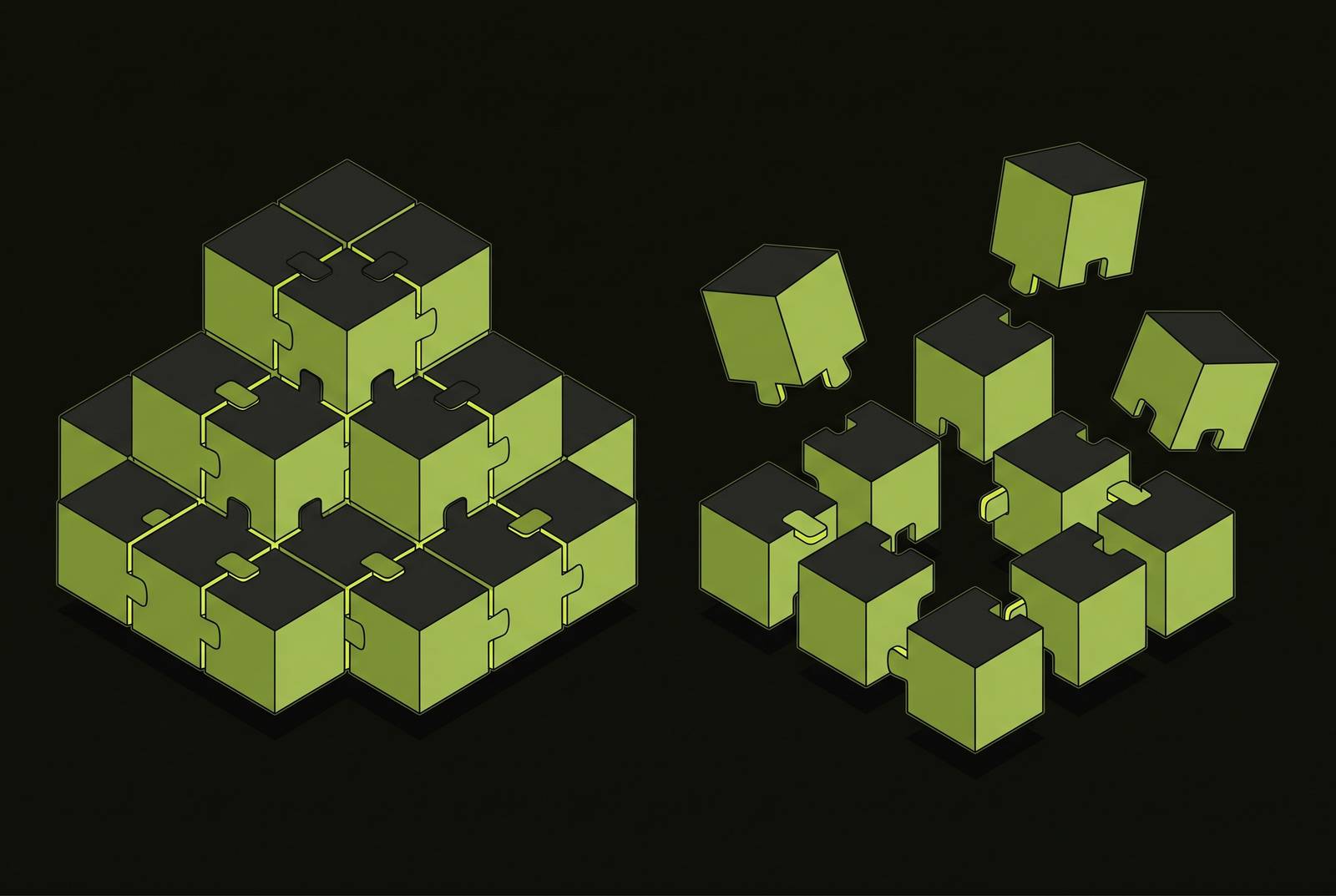
A platform engineer evaluating vendors in 2026 will hear the word "modular" in nearly every sales conversation. The term has become the default shorthand for architectural sophistication, and it is doing real work in obscuring a distinction that matters more than component count. Modularity describes the parts. Composability describes the system that connects them. A platform assembled from dozens of separable components can still require teams to redesign dependent services every time one of those components changes, and that is where the pitch collapses.
Broadcom's Pankaj Gupta draws the exact line. Infrastructure, he argues, should be "a set of building blocks connected through well-defined contracts," meaning APIs, policies, and service expectations that let each layer evolve without forcing changes throughout the rest of the platform. His framing moves the conversation explicitly "beyond simply offering a catalog of tools." The practical gap is easy to demonstrate. Replace a CI/CD component in a loose-parts platform, and the change cascades into redesigning every dependent service that touched it. Replace it inside a contract-based platform and the contract absorbs the change at the boundary, leaving everything above and below undisturbed. That is the difference between having components and having a system.
What genuine composability requires beyond interchangeable parts
A composable platform is defined by its control plane, not by the number of tools in its catalog. The control plane is what a genuine composable vendor actually sells. It is the mechanism that holds components in governed relation to one another, and its presence or absence determines whether a swap is an operational event or an architectural emergency. Gupta introduces "repavability" as the practical test for this property. Teams need to rebuild confidently and quickly when they replace components, and they need ways to compare performance, assess user satisfaction, and move traffic between implementations. Having interchangeable pieces is not enough if replacing them creates uncertainty or disruption.
The distinction this creates is structural. A loose-parts DevOps platform delivers tools. A composable vendor delivers a converging system, one that keeps returning to a governed state regardless of which components are swapped. The CNCF Platform Engineering 2.0 framework identifies composable architecture as one of five pillars, not as a feature but as a structural requirement. Platform capabilities must be delivered as modular, independently deployable, API-first building blocks so teams can swap one CNCF-compliant tool for another with equivalent functionality without cascading changes. If these are the structural requirements, then a platform engineer can inspect any vendor against them, and most vendor pitches will fail at least one.
The four-question diagnostic a platform engineer can run before signing
The test for true composability is not what a vendor claims but what survives a component swap. Four questions expose the difference between a governed contract and a well-packaged catalog. Question 1 is contract or handshake. Ask the vendor to show the API contract that governs how its CI/CD layer communicates with its policy layer. A composable vendor has a versioned, documented interface. A loose-parts platform has an integration guide written by a solutions engineer, and the two are not the same artifact.
Question 2 probes the policy engine behind that contract. The engineer should ask how policies are enforced across component boundaries. The answer reveals whether governance lives in the control plane or in tribal knowledge distributed across the team that built the integration. Question 3 is reconciliation or snapshot. Ask what happens when live state drifts from declared state. A composable platform continuously reconciles, pulling the system back toward its governed configuration without human intervention. A loose-parts platform reports the drift and waits for a human to fix it, which means drift accumulates silently between incidents.
Question 4 is repavability under load. Gupta's repavability test asks whether the platform provides processes that make replacing a component operationally safe rather than merely architecturally possible. Traffic shifting, performance comparison, satisfaction measurement. These are the mechanisms that let a team rebuild confidently while the platform runs. A vendor who answers questions 1 and 2 confidently but stumbles on 3 and 4 has built a good catalog. That is a useful thing, but it is not a composable platform, and the engineer should price it accordingly.
Why AI-native workloads make the contract-versus-catalog gap impossible to ignore
Agentic AI workloads expose the catalog model's failure mode at a velocity human teams never produced. Autonomous agents collaborating across the software development lifecycle generate integration pressure that implicit coupling cannot absorb. The CNCF blog on Platform Engineering 2.0 is direct about the scope of the problem. Platforms were not originally designed around requirements such as GPU provisioning, model lifecycle management, MCP integration, or governance for AI-driven systems. The framework identifies sovereignty and compliance pressure, multi-persona expansion, and the need to support autonomous agents and AI-native workloads as key emerging challenges for today's platform teams.
Gupta's discussion places these new capabilities, MCP servers and AI gateways among them, inside the architecture itself. A catalog-style platform has nowhere to put them without cascading integration work. The structural test that AI makes unavoidable is this: a platform that cannot give an agent a governed sandbox with triggered CI and policy-enforced merge gates is not composable. It is a patchwork. The agent's sustained, multi-step execution across the SDLC requires every layer to honor the same contracts, and implicit coupling breaks on the first long-running agent task.
The merge queue is the clearest production stress point. AI coding acceleration has multiplied pull request volume without expanding the merge infrastructure sized for human typing speed. A platform without governed merge contracts and agent-aware queue management cannot scale the delivery pipeline to match agent output rate. The familiar objection, that integrations can be added as agents arrive, fails the repavability test. Adding integrations to a catalog-based platform does not create a contract. It creates more implicit coupling that the next swap will have to unpick.
The merge queue as a concrete site where contracts beat catalogs in production
The merge queue is where the absence of governed contracts becomes a delivery crisis. Without explicit lane contracts, policy-enforced merge gates, and isolated test environments per queue entry, the queue serializes on test infrastructure rather than on the merge decision. That was never its job. The mechanism is straightforward. If merge-group CI runs end to end, a strictly ordered queue can process a fixed number of pull requests per hour. Let each developer run agents and the arrival rate multiplies while the service rate stays fixed. Wait times do not grow linearly. They explode.
The common first response is to add more parallel CI runner capacity. That addresses compute, not coupling. When the real constraint is a shared deployment target that every queue entry's test step depends on, more runners do nothing, because the bottleneck is architectural rather than computational. The contract-based fix gives every queue entry its own full-stack, isolated environment through a governed API, so testing one entry never waits on another. The queue still serializes the merge decision, which is its actual job, but it no longer serializes on test infrastructure.
Lane separation is the second contract requirement. A 2026 analysis found that human review throughput collapses structurally when AI-generated pull requests exceed 15 to 25 percent of total queue volume without explicit lane segregation. Separating human-review lanes from agent-review lanes is an architectural contract, not a configuration option. This is also where an agentic merge queue, one where an AI agent handles conflict resolution, CI failures, and queue management while reserving human judgment for meaningful decisions, stops being a feature addition to a catalog platform and becomes a first-class contract component of a composable one. Without the governing contracts, an agent operating in the queue has no stable surface to act on.
Agent transcript analysis as the feedback contract that closes the loop
Production signals in catalog-style platforms accumulate in dashboards that neither agents nor developers are structured to consume. Exceptions, deploy failures, query issues. The feedback loop is broken by design because the dashboard is not a contract surface. Agent transcript analysis is the mechanism that makes this loop operational. Surfacing how AI coding agents are actually using their skills in production, which tools they invoke, which skills go unused, where they fail, gives platform engineers a governed signal for trimming dead weight and tuning agent harnesses.
The structural argument is that this is a contract requirement rather than a nice-to-have. A platform that does not surface agent transcripts as first-class operational artifacts cannot be tuned or governed. Tuning without transcripts is configuration drift by another name. Bloated agent skill sets actively hurt performance. Removing unused skills is as important as adding new ones, and only a platform that surfaces transcript evidence of skill usage can make that case with data rather than intuition.
Code storage and version control as a composability contract, not a commodity layer
Cloud-native agents impose different performance characteristics on code storage than human developers do. A platform that serves agents from a human-first version control system has a contract mismatch at the foundation. The mechanism is clear. Human-paced workflows tolerate latency at the storage layer because a developer reading a diff is the bottleneck. An agent operating inside a CI/CD pipeline at machine speed is not, and the storage layer becomes a serialization point if its throughput assumptions were sized for human typing speed.
High-performance code storage with synchronization designed for cloud-native agents, not bolted onto a human-first workflow, is the composable answer to this layer. It treats the storage API as a first-class contract that agents consume at machine speed rather than a convenience layer that humans browse. The composability test applies here as it does above. Can the storage layer be swapped or upgraded without cascading changes to the CI/CD and merge contracts above it? A catalog-style platform wires the storage to the pipeline through implicit assumptions about latency, API shape, and sync behavior. A composable platform defines those assumptions as versioned contracts. If the storage layer fails that test, every contract above it rests on an ungoverned foundation.
Applying the framework: what to look for when a vendor calls itself composable
A vendor that uses "composable" as a marketing term and a vendor that has built a genuine contract-governed system look similar in a demo. The difference appears only when the seams are stress-tested. Ask to see the versioned API contract between any two components, not the integration documentation but the contract itself. Ask what the platform does automatically when live state diverges from declared state, not what it reports but what it does.
Ask how the platform handles a new agent persona. Does it provision a governed environment with policy-enforced merge gates, or does it require the team to wire those together from catalog entries? The answer separates structural composability from rhetorical composability in one question. The software factory, automated and agent-driven pipelines operating at machine speed, is a distinct infrastructure category. It deserves tooling whose composability is structural, not rhetorical. The contract-versus-catalog test is the fastest way to tell which vendors have understood that, and the platform engineer who now holds the test has the leverage. The vendors have to pass it.