What Makes a Software Factory Different From a Standard Engineering Org
It's a self-reinforcing feedback loop, not a pipeline with human handoffs.
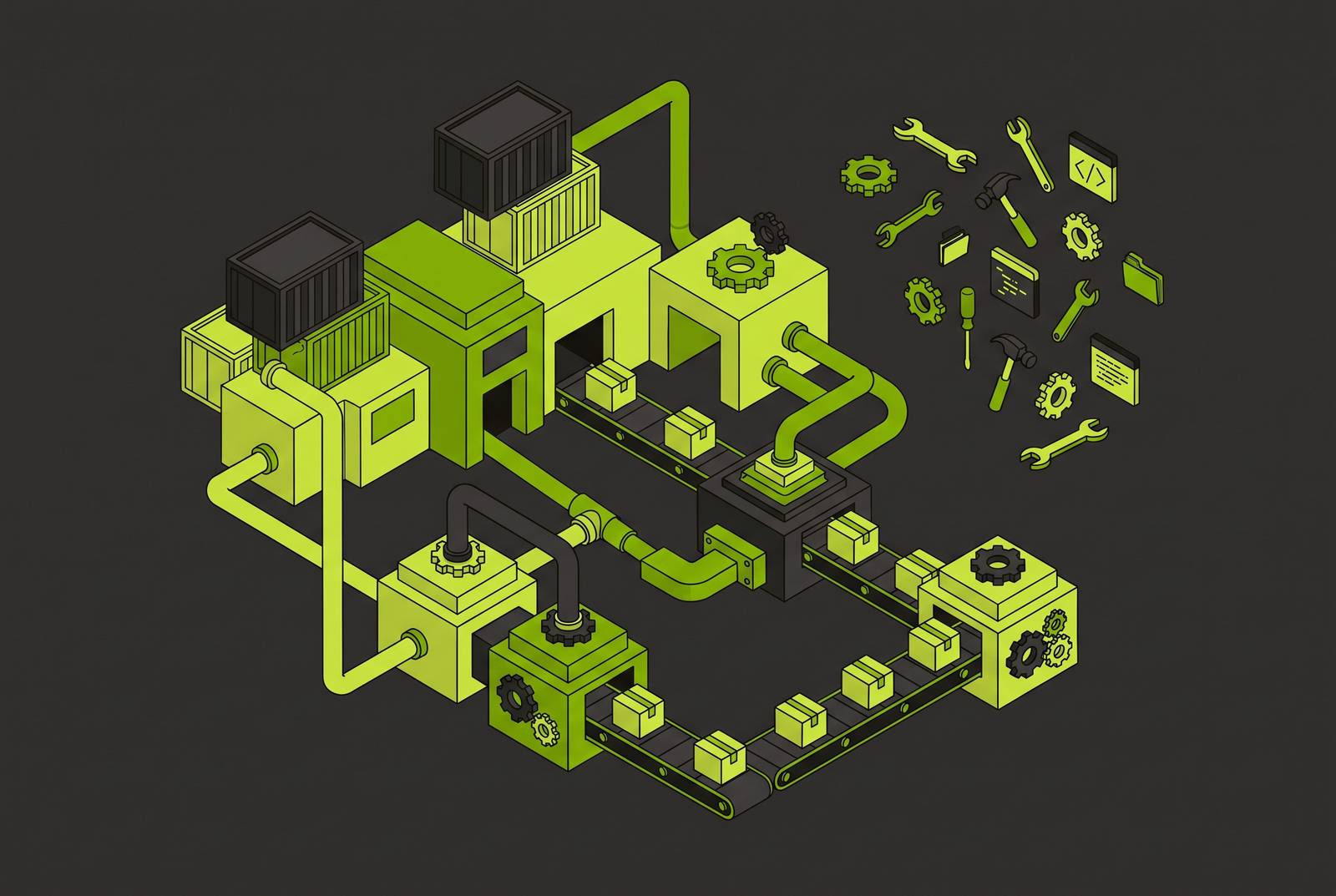
The difference between a standard engineering organization and a software factory is not headcount, tooling, or how much AI a team happens to use. It is what the organization is designed around. A standard org is built around individual contributors who move work through discrete phases. A software factory is designed around a self-reinforcing loop where signals drive artifacts and artifacts generate the next signals.
In a standard org, work decomposes into phases: plan, build, test, ship. Each phase belongs to a person or a team. Performance is measured per contributor, and the implicit unit of design is the engineer and their throughput. The org chart reflects this. Teams, managers, and career ladders all map to the human who does the work.
The software factory inverts this. Factory's 2026 announcement describes the model precisely: signals from bug reports, conversations, and requirements enter the system. Those signals become planned changes. Changes are built, tested, reviewed, secured, shipped, and monitored. Monitoring generates new signals, which feed back into triage and planning. The whole thing is a continuous feedback loop, not a pipeline with endpoints.
The loop is the unit of design, not the sprint, not the engineer, not the ticket. That single shift changes everything downstream: what tooling the org needs, where controls belong, and what humans are actually for. The question of what humans are for is the one that matters most, because the answer is not what a standard org chart would predict.
What makes the loop self-reinforcing rather than just a faster pipeline
The loop itself is not new. Plan, build, ship, monitor has existed for as long as software development has had a name. What has changed is that AI agents can now do meaningful work at nearly every phase of the loop, which means the loop can run continuously rather than stalling at human-speed handoffs.
Earlier tools accelerated individual phases. A faster compiler sped up the build. A better test framework sped up testing. But every phase still ended with a human picking up the output and carrying it to the next phase. That human handoff was the rate-limiter, and it reset the loop each cycle. The loop did not compound. It merely repeated.
Agents change the restart logic. The loop ran with minimal human restarts. At Stripe, a coding agent called Minions sends more than a thousand pull requests per week to production that contain no human-written code. Humans review and approve, but they do not restart the cycle.
For the loop to be genuinely self-reinforcing rather than merely fast, the organization must own a system that learns from itself. The source calls this sovereign intelligence, and the term is apt. A factory that depends on an external model to remember its context is not a factory. It is a set of rented tools arranged in a circle.
The self-reinforcing property is also the source of the factory's compounding risk. A loop that improves over time also amplifies errors over time if the feedback signals are wrong or the controls are too weak to filter them. The same mechanism that makes the factory powerful makes its failure modes worse, and faster.
Why intent engineering, not code generation, is where the loop begins
A software factory does not begin with code generation. It begins with intent engineering: converting business requirements into machine-readable specifications before any implementation starts. The reason is structural, not stylistic. Agents cannot hold the engineering context that humans carry implicitly, so that context must be encoded somewhere upstream or it will be lost.
Opsera's software factory model describes the failure pattern with uncomfortable precision. The tests pass. Architectural drift compounds anyway.
The predictable output of a pipeline that starts with generation rather than intent is visible in the 2026 Reddit thread engineers describe: inherited AI-assisted codebases that passed tests yet lacked any shared rationale for architectural decisions, with duplicated patterns and inconsistent implementations. Passing tests are not evidence of coherent design. They are evidence that the tests pass.
The structural fix is to convert approved specifications into machine-readable Work Orders with defined scope, dependencies, and acceptance criteria before agents begin. Governance becomes part of software generation, not a review after implementation. Architecture approvals, security policies, and compliance checks validate specifications before development begins, not after.
Unlike AI code assistants, software factories maintain persistent context across the full SDLC. The context is not in a chat window. It is versioned infrastructure.
The standard org analog is instructive. An engineer reads it, interprets it, and carries its intent forward in their head. The software factory makes that intent explicit, machine-readable, and present at every downstream stage. The engineer's implicit understanding becomes structural, which means it survives the engineer's absence and scales to any number of agents.
How higher throughput breaks controls designed for human volume
The controls that protect a standard engineering org, code review, CI queues, merge processes, were sized and designed for human typing speed. When agents produce pull requests at agent speed, those controls become the primary bottleneck and, under stress, the primary failure mode. The capacity math is unforgiving. And when arrivals approach capacity, wait times do not grow linearly. They explode.
Agents amplify flake in a qualitatively different way than humans do. An agent instructed to get a PR merged will re-queue the same change repeatedly, burning full CI runs on each attempt and re-triggering cascade failures for everyone behind it. Retry loops that were mildly wasteful at human frequency become effectively a denial-of-service at agent frequency.
The DORA 2025 findings confirm the pattern at the organizational level. AI adoption correlates with higher software delivery instability and more unplanned deployments, or rework, when the surrounding engineering system is not designed to handle AI-generated output at scale. The result is more throughput and worse outcomes, because the controls did not scale with the volume.
Atlassian's deployment of merge queues across its Jira team is a concrete production case. Internal incidents from merge conflicts fell from multiple per week to rare edge cases. The fix was not simply faster CI. It was a different triggering model.
The merge queue must create ephemeral merge groups validated against the latest target state, and CI must subscribe to the merge group event, not the pull request event. Without that distinction, the queue is a label, not a control. That CI event distinction is the sharp technical detail that separates a real merge queue from a symbolic one.
Microsoft's account of building its Azure SRE Agent is a named case in the same register. The shift was from more than a hundred bespoke tools, 50+ specialized agents, and a prescriptive prompt to a filesystem-based context engineering system with 5 core tools and a handful of generalist agents. Context architecture, not model selection, was the lever that changed performance. The same compounding logic applies to agent skill sets. A bloated set of skills degrades performance because agents invoke tools that do not apply to the task, increasing noise in the transcript and obscuring the signal that would let the system improve. Unused skills are not neutral. They are negative.
What production signals have to do with the loop closing properly
A software factory whose feedback loop stops at merge is not a loop. It is a pipeline with an observation window bolted on. Production signals must re-enter the system as structured inputs that agents can act on, not as dashboards that humans monitor manually.
Factory's model is explicit on this point. Monitoring deployed software generates more signals. Those signals feed back into triage and planning. The loop only closes if instrumentation spans every stage, including post-deployment. A factory that treats monitoring as a downstream activity has not built a factory. It has built a pipeline and attached an alarm to the end.
The failure mode when production signals do not feed back is documented. The Cortex 2026 Engineering Benchmark Report found pull request throughput rising while incident volume rose even faster. That is a productivity paradox: organizations produce software faster than they can safely operate it, because the production signal is not feeding back fast enough to slow or redirect the generation side.
Dropbox's published governance stance is a concrete organizational model for how the feedback enters the loop. Define the task, allow the agent to execute within established guardrails, validate the result, and have a human make the final judgment before any code reaches production. The key detail is that production signals inform the task definition at the front, not just the retrospective at the back.
The standard org equivalent is agonizingly familiar. In a software factory, an incident correlates directly with the PR that caused it, and that correlation becomes an input to the next agent session automatically. The signal does not wait in a queue. It changes the next task definition.
Why composable infrastructure is a structural requirement for the factory, not a preference
A software factory that bets on a monolithic platform bets that one vendor's component choices will remain the best choices across every layer as the ecosystem evolves at AI speed. That bet has already failed for most organizations, and the pace of change makes it structurally untenable. The winning pattern in 2026 is composable. Teams can swap one tool for another without cascading changes. The platform can be updated quickly as the ecosystem evolves.
Platform Engineering 2.0 delivers capabilities as modular, independently deployable, API-first building blocks. Crossplane is one concrete example: developers request a composite resource as a Kubernetes object, and the controllers provision all underlying cloud resources. Cloud infrastructure becomes declarative and GitOps-managed. Factory's model independence requirement is a direct expression of the same logic. No single model fits every need within an enterprise, and as models commoditize, the factory must be able to switch or route between them without rebuilding the surrounding system.
The standard org's infrastructure posture, buying one platform that does everything, was defensible when human engineers were the consumers and switching costs were high. Agents are indifferent to UI and interact through APIs. Best-of-breed assembly becomes cheaper, and monolithic lock-in becomes more costly.
Code storage and version control for cloud agents requires different performance characteristics than traditional developer tooling. A pull request in a scoped small repository can clear CI in a fraction of the time the same work requires in a monorepo. At agent-generated PR volume, that difference determines whether the merge queue can keep pace.
GitOps is the integration layer that makes composable infrastructure auditable. Git becomes the single source of truth for deployments. For agent-generated code, version control does double duty. It is the deployment mechanism, and it is the audit trail.
Where human judgment belongs in a factory, and why that role is more demanding than it looks
The software factory does not reduce the importance of engineers. It concentrates their work on the decisions that compound most: what the system optimizes for, where the controls are set, and whether the outputs are good by the standards that matter to the business. Factory's framing of the engineer's role is precise. Engineers are no longer the sole custodians of building the software. They are responsible for building the factories that build the software. With that comes governance, safety, and ownership of business outcomes. Engineering responsibilities grow to span the business itself.
Autonomy is a maturation process, not a binary. Complex tasks decompose into parallel multi-agent tracks. Not every process should use long-horizon autonomous execution, and how much human guidance you need varies by information sensitivity and how ready the task is for delegation.
The trust gate is structural, not cultural. Dropbox's model, define the task, allow execution within guardrails, validate the result, human makes the final judgment before code reaches production, is not a policy. It is an architectural constraint built into the loop.
The strongest objection is that this is assembly-line thinking applied to creative work. The answer is not to deny the creative dimension but to observe where it actually lives: in defining what good output looks like, in setting the criteria the inspection process enforces, in deciding what the factory optimizes for. The factory model requires that criteria for a good product span functional requirements, testing, security, performance, accessibility, and design consistency. Humans define those criteria. Agents apply them at scale.
The engineer in a factory is not watching the line. The engineer is designing the standards by which every output is judged, setting the bounds within which autonomous execution is allowed, and deciding what the system is optimizing for. That is more demanding than writing the code. It is the work that compounds.