How to Version Artifacts When Agents Are the Primary Pipeline Consumer
Version code, prompts, models, and tools as a single release unit.
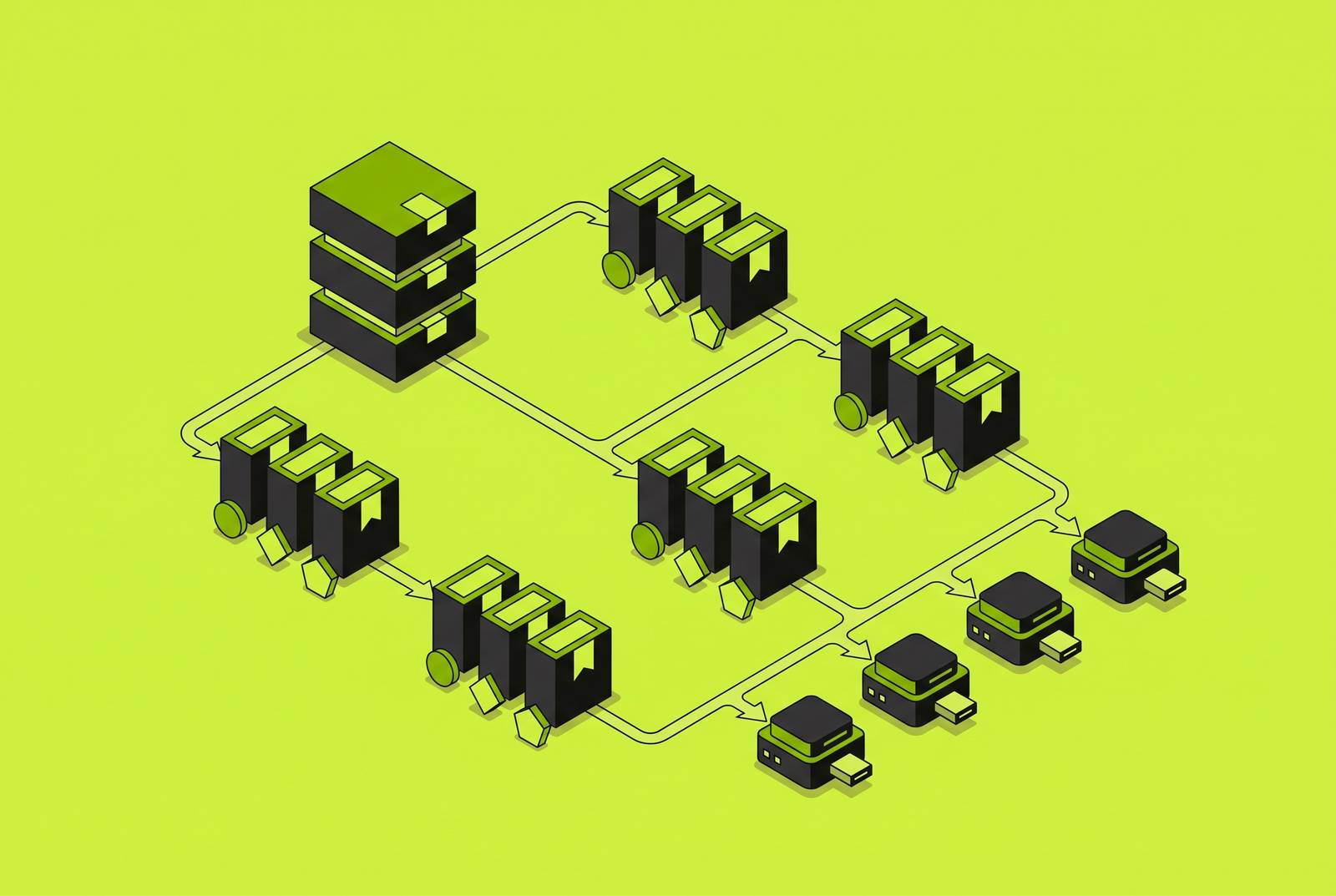
Artifact versioning for agent-first pipelines must capture the system that produces behavior. That means versioning code, prompt templates, model versions, and tool contracts as one release unit. Repository governance, behavioral testing, and production feedback then make that unit traceable, testable, and reversible.
Why traditional artifact registries fail when agents are the primary pipeline consumer
Traditional artifact registries track the compiled code or container image for a service. That gives a pipeline an identity for what it deploys, but an agent’s behavior depends on inputs beyond that artifact. A different prompt can change the work it attempts, while a different tool contract can change what it can accomplish. Either change can happen without a change to the executable. The registry can therefore identify the code correctly while leaving the effective agent version unresolved.
This mismatch grows because the dependencies run in all directions. Agent outputs are also probabilistic, so byte-level identity cannot establish behavioral equivalence. Conventional CI/CD can check that X equals Y, but a registry cannot tell whether different answers are acceptable variation or a regression. Cloudflare launched its Artifacts beta in May 2026 to address agent outputs that are “often ephemeral, lacking clear lineage or auditability”. The gap is therefore not merely an awkward release workflow, but an incomplete record of what produced an output.
The four layers that must be versioned together, and why uncoupling them breaks agent behavior
An agent’s effective behavior depends on four coupled layers, namely code, prompt templates, model version, and tool/API contracts. Code supplies the executable logic and remains subject to standard Git semantics. The prompt shapes the task and instructions, while the specific model checkpoint changes the distribution of possible outputs. Tool contracts define the operations available to the agent. Versioning any of these in isolation creates a record of a component.
For example, take a change to a prompt that leaves the code, model, and tool contracts the same. A one-word change can alter behavior without a corresponding change that static analysis catches. Replacing the model can also change outputs even when the code and prompt are byte-identical. A breaking tool change can also change what the agent accomplishes without touching either. Each layer is therefore an independent source of behavioral drift.
Prompts need their own release cycle and registry. Tool metadata must also remain attached to the artifact it describes. Cloudflare Artifacts uses git-notes to attach prompts, agent attribution, and other metadata to Git objects without mutating those objects. Together, these requirements make a manifest that pins all four layers the minimum unit of traceability.
Treating agent definitions as first-class versioned artifacts in the repository
The foundation is to define, store, and govern agents in the repository through the same lifecycle as other code artifacts. This is the agents-as-code equivalent of replacing snowflake infrastructure with versioned definitions. An agent’s instructions and restrictions become reviewable changes rather than settings held outside the release process. Feature branches support experimentation, pull requests support discussion, and git blame provides a path back to a change. These controls use the version-control infrastructure already in place.
AGENTS.md supplies passive, always-on instructions for coding agents, including build commands, code style, testing instructions, and hard boundaries. The Agentic AI Foundation under the Linux Foundation stewards this cross-platform pattern, which can be nested within monorepos. Custom agents in .github/agents/ use .agent.md files to define specialists that are active and can be switched. Each can carry tool restrictions, model selection, and workflow handoffs, with organization-level definitions providing consistency across repositories.
The hierarchy starts with instructions for the organization, then adds AGENTS.md context for each project, then custom agents for specific tasks. Teams can fork and customize definitions while retaining a governed baseline. Because those definitions live with the code, a developer who clones the repository gains access to the same versioned agents configured for that codebase. Repository storage makes the definition subject to an established change process.
Building the version manifest and pinning all four layers into a single reproducible unit
The manifest turns repository governance into a release contract by pinning the code commit, prompt artifact hash, model identifier, and tool contract versions together. This combination is the minimum deployable unit for an agent-first pipeline. A code commit alone cannot identify the prompt used at deployment, and a prompt hash alone cannot identify the tool capabilities available then.
Prompt text, model selection, and all relevant parameters should be bundled into an immutable file, such as JSON, and stored in Git. That gives the prompt a hash, a diff, and a revert path like source code. Each tool or MCP server the agent calls should likewise have an explicit version in the manifest. Otherwise, a breaking tool change causes behavioral drift that the manifest does not show.
The reproducibility approach described for Vertex AI Pipelines extends the same principle to inputs beyond the four core layers. Pipeline components run in containers stored in Artifact Registry, while reproducible runs require pinned code, data, dependencies, configuration, environment, and random seeds. Where training data forms part of the release, BigQuery snapshots or Cloud Storage versioning can pin it, with snapshot hashes supporting integrity verification. The portable principle is to pin the inputs that define the run. CI should refuse promotion when the manifest contains unpinned or mismatched layers.
Why behavioral regression testing must replace binary assertions as the promotion gate
A complete manifest identifies a release, but it does not establish that the release is safe. Because agent outputs are probabilistic, an expected-string assertion cannot carry the promotion decision. The gate must instead check whether behavior stays within acceptable bounds across a sample of inputs. The configuration stays the same even though its outputs can vary.
Prompts and evaluation datasets should be versioned with code, and the evaluation dataset should be pinned in the manifest. Behavioral tests then check a proposed prompt version before it reaches production. LLM-as-Judge provides an established design pattern for such gates. Its results support a promotion decision about the sampled behavior.
Production monitoring supplies the second gate because offline evaluation cannot capture every live condition. The VS Code team uses offline benchmarks before shipping, then A/B tests and signals from overall usage once changes are live. This lets the team detect regressions before a release and drift after it. It also makes the connection to versioning explicit, since rollback requires a manifest that records the configuration and evaluation inputs associated with the known-good state.
How transcript analysis closes the feedback loop between production behavior and manifest updates
Production scores show whether a release is meeting expectations, but transcripts show what the agent actually did with its tools. An agent may have access to capabilities that contribute nothing to its work, or it may use tools differently from what the definition intended. Transcript analysis gives teams the evidence they need to decide whether to change a manifest layer. Without that evidence, teams keep a version record but cannot see enough of what the system does.
Unused tools add context and latency and increase the failure surface. Transcripts distinguish live tool use from dead weight, making removal of an unused skill a meaningful release change. The resulting manifest update records a narrower capability set. That gives subtraction the same governance as adding a new tool.
This evidence also connects operational behavior to access policy. Non-human consumers need credentials of their own, a least-privilege scope, and an audit trail. Transcript analysis helps demonstrate whether tool use honors those limits in practice. The feedback loop therefore does more than improve output quality, since it informs both the next version and the scope of access that version requires.
What the merge queue sees when versioning breaks down, and how to design the pipeline boundary
Inconsistent versioning becomes an operational problem when coupled-layer drift reaches the merge queue as CI failures and repeated retries. Agents that get unclear or mismatched version signals can re-queue the same change, using a full CI run each time. A queue sized for human typing speed takes a hit to throughput when changes arrive at that rate. What was mildly wasteful at human frequency can become a denial-of-service at agent frequency. The versioning defect then affects changes beyond the one that caused it.
Flaky tests amplify the problem because an agent instructed to get a pull request merged may retry without distinguishing a transient failure from a meaningful one. A queue that makes no such distinction turns every failure into another demand for CI capacity. More retries repeat the cost of discovering the same manifest incompatibility.
The agentic merge queue is the boundary at which versioning policy can be applied programmatically. An agent operating that queue can handle merge conflicts, CI failures, and queue management within the encoded policy. Decisions that require judgment the policy cannot express should escalate to humans.
Code storage and version control requirements that human-first tools were not designed to meet
Queue policy depends on a storage layer that can serve agent activity at pipeline speed. Human-first Git workflows are optimized for cloning once and committing occasionally, while agents clone, read, write, and push at machine frequency. Approximately 90% of agent tasks result in a file that needs somewhere to go, whether cloud storage, version control, or a stakeholder. Storage is therefore part of the active execution path rather than an occasional destination for completed work. Degradation at that layer propagates into pipeline throughput.
Agents need discoverable APIs through which they can list resource types, read schemas, and watch for change events without tribal knowledge. A human-readable repository interface does not natively provide that contract. The distinction matters because access to a repository is not the same as an interface an agent can navigate reliably.
The credential model must also be supported at the storage layer. Reliable access and scoped identity are prerequisites for serving governed definitions to non-human consumers. Otherwise, the organization-to-project-to-custom-agent hierarchy can be correct in Git yet unreliable in operation. Sound versioning semantics cannot compensate for a substrate that fails to deliver the versioned material quickly and consistently.
A composable versioning stack for software factories, assembled from what the team actually needs
These requirements form a composable stack rather than a mandate to replace the entire delivery platform. Repository-based definitions establish governance, and immutable manifests bind the release inputs. An agent-operated merge queue enforces policy at the CI boundary, supported by storage designed for agent access patterns. Each layer has a distinct responsibility and can be addressed where the team has a gap.
A team with sound container versioning needs to extend its release model to include prompts, model versions, and tool contracts. Likewise, teams do not need to add every layer at once just to follow a platform blueprint. CNCF’s Platform Engineering 2.0 framework, published in July 2026, includes composable architecture as one of its five pillars for the move toward an AI-native platform.
The strongest objection is that Git semantics fit poorly with the probabilistic, iterative nature of agent work. That objection identifies the tension but not a reason to abandon traceability. Git does not need to make outputs deterministic to make definitions and release inputs reversible. The discipline is to record what produced behavior, test whether that behavior is acceptable, and preserve a path back when it is not. That is how versioning becomes a control on agent risk without becoming a constraint on iteration.