Branch Strategy Design for Agent-Driven Pull Request Workflows
AI agents need branch strategies designed for high-volume parallel pulls, not human workflows.
An agentic coding workflow is an end-to-end software development process in which an autonomous or semi-autonomous AI agent handles implementation: writing code, running tests, interpreting failures, and opening pull requests, while humans define objectives, review output, and manage deployment decisions. Agent-driven workflows break the assumptions baked into branch strategies built for human engineers, and the fix is not an adaptation of an existing convention but a purpose-built branch topology designed around parallel execution and queue-aware integration.
What an Agentic Coding Workflow Actually Is
The feature that separates agentic coding from earlier generations of AI-assisted development is architectural. A coding agent executes multi-step tasks inside a persistent execution environment without needing a human to approve each move along the way; a single agent can plan a change, write it, run the test suite, read the failure output, and revise, all inside one continuous run.
From a platform-engineering standpoint, this workflow has three working parts. The first is the agent itself: the environment, tools, and policy constraints that bound what it's allowed to touch. The second is the change-management surface: the pull request and merge queue through which the agent's output actually enters the codebase. Branch strategy lives entirely inside that second component, and it is the component least prepared for what agents are about to do to it.
A developer account posted to a workflow forum in mid-2026 describes the practical shape of this shift. The author, posting as u/TornadoTurbine3000, spent three months letting Claude write code inline inside conversations, copying it into files by hand, committing it personally, and cleaning up afterward. Every PR starts as a draft until someone marks it ready, and when CI fails, Claude reads the failure log and fixes it without anyone having to re-prompt it.
Code no longer lives inside a conversation. What remains unresolved, by the author's own admission, is coordination: running two Claude instances against overlapping files risks collision, and the current workaround is simply trying to avoid letting that happen, with the author acknowledging that a smarter coordination approach probably exists and isn't yet in use.
That gap between individual practice and structural solution is exactly where branch strategy has to do its work.
Why Branch Strategies Break Under Agent Load
Branch strategies built for human teams assume a small, stable set of contributors making deliberate edits to long-lived feature branches. Agents break each of those assumptions, and the breaks pile up at the integration layer instead of staying contained there.
Volume is the first break. A single developer running a few agents in parallel can generate more open pull requests than an entire squad produced before agents existed. Branch strategies built around single-digit PR counts per developer per day collapse when agents produce dozens of PRs in that same window, because the review and CI infrastructure downstream was never sized for that arrival rate.
Conflict surface is the second break. Human contributors coordinate informally: a team simply knows not to touch auth.ts at the same time as someone else. Left uncoordinated, multiple agents editing overlapping file paths will generate conflicts that have to be resolved before anything merges, and those conflicts compound queue depth rather than resolving quietly.
Lifecycle mismatch is the third break. A branch that lingers invites staleness, merge debt, and CI drift, and all three of those problems get worse, not better, at agent frequency.
Queue coupling is the fourth break, and the one with the sharpest mathematical consequence. Merge queues sized for human PR rates become saturated once agents multiply the arrival rate. Queueing theory holds that at high arrival rates, small increases in queue depth produce disproportionately large increases in wait time, and teams experience this directly as a merge queue that was running fine suddenly taking hours to clear.
Two branch strategies currently dominate software teams, and each one responds differently when agents drive up volume. Its advantages are structural: no long-lived branches, smaller and easier merges, continuous automated testing, simplified release management, and fast feedback loops.
GitFlow takes the opposite approach, built around two permanent branches (main and develop) alongside temporary branches for features, releases, and hotfixes, with pull requests merging feature work back in. Its advantages are organizational: clear separation of feature, release, and hotfix work, strong visibility through PRs, and room for long-lived branches on genuinely complex features.
AI coding tools press on both strategies in the same direction.
The choice isn't universal. If your team is organized around formal releases, sits under compliance requirements that demand stable release branches, needs the visibility long-lived feature branches give, or manages genuinely complex features across multiple agents at once, GitFlow with AI tools suits you.
What a Purpose-Built Branch Topology Looks Like
Neither strategy was designed with agents in mind, and patching either one with policy addresses symptoms rather than causes. A branch topology built specifically for agent-driven PR workflows solves each failure mode structurally.
Conflict gets addressed before it happens, not after. Agents should claim the files they intend to modify before branching, not after, through a file-level or path-level reservation system that behaves like a write lock without blocking reads. This stops two agents from starting divergent edits on the same path in the first place, eliminating the conflict at its source rather than resolving it at merge time.
Branches get scoped to the task. Each agent task gets its own branch, which keeps branch lifetime measured in the minutes or hours of the agent's execution window rather than the days of a human iteration cycle. Narrow scope produces narrow diffs, so they cost less to review, run faster to test, and are less likely to collide with anything else in flight.
Naming becomes a signal. Reviewers and automated systems alike need to tell agent branches from human branches, active branches from abandoned ones, and then route each branch to the right CI configuration and policy tier. A naming schema that encodes task ID, agent identity, and creation timestamp gives the merge queue, the PR router, and the review system what they need to make those distinctions without anyone reading the diff first.
The merge queue is the actual authority on integration correctness. An individual pull request only tests its branch against the base as it existed at branch creation time. In a high-velocity environment, the merge queue is where integration correctness gets verified for real. Queue checks have to run against the speculative merge-group commit that would land on main if the batch merged, so the CI configuration has to include the merge_group trigger alongside the pull_request trigger.
Abandoned branches get cleaned up automatically. If an agent fails mid-task, or gets retried from a fresh branch, it leaves orphaned branches behind. Left unmanaged, the repository accumulates branch noise that degrades discoverability and distorts tooling signals. A reaper job that closes and deletes branches with no activity after a configurable window, with no open PR or only a closed one, removes that noise with no human effort required.
The Merge Queue as Infrastructure
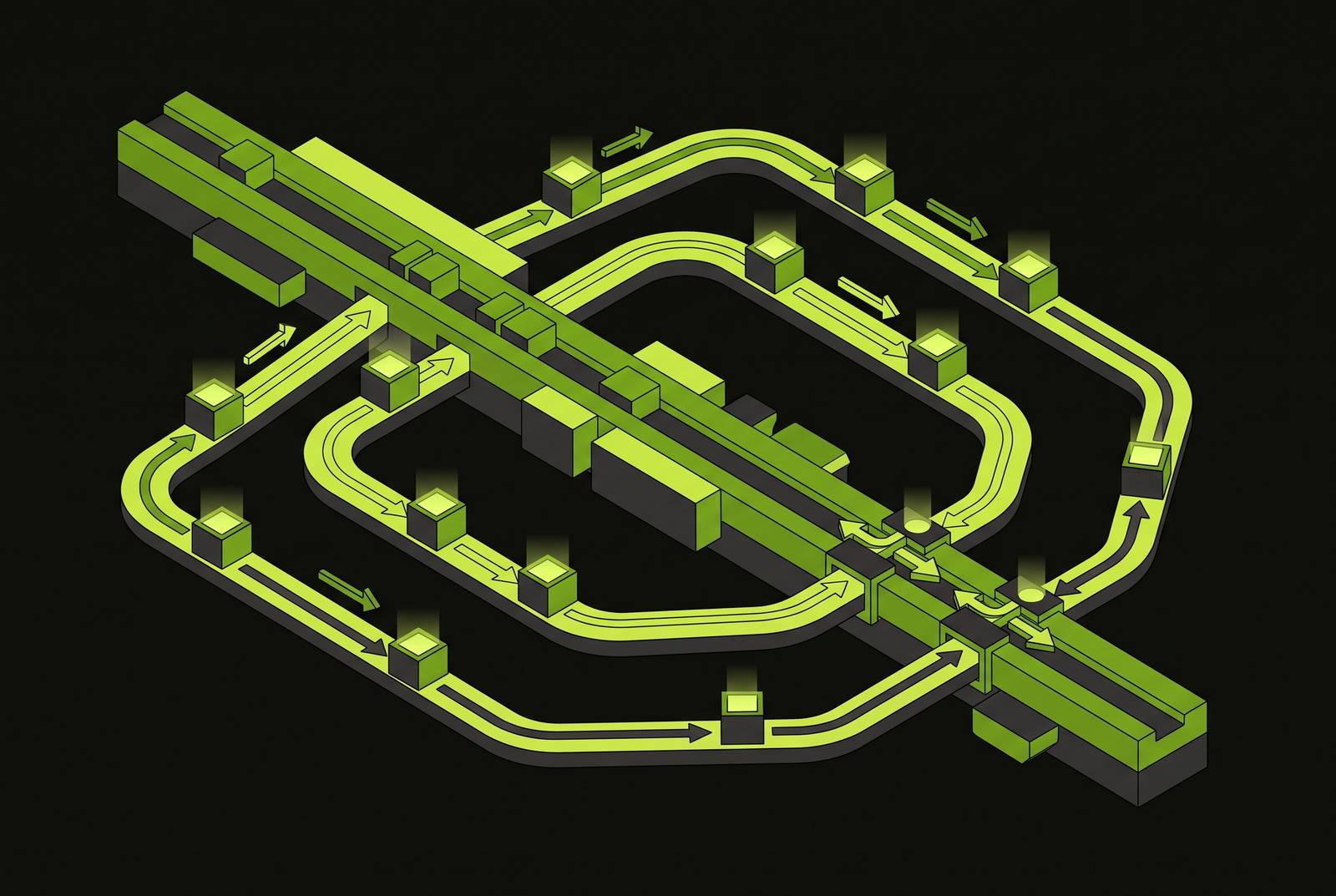
GitHub's merge queue documentation describes the mechanism in concrete terms: a pull request's changes merge only after all required checks pass against the code of every other pull request already ahead of it in the queue, which raises merge velocity in a busy branch without sacrificing the integrity of what lands. Normal PR review and approval continue exactly as before. The queue only changes how final integration happens.
Pull requests are grouped together where possible; the size of a given merge group depends on the number of required checks, the number of checks unique to specific PRs in the queue, and how many PRs are already waiting. Configuration allows limits on minimum and maximum group size, from 1 to 100, along with a wait time for group formation. Failure handling is explicit: when a PR fails in the merge queue, it's removed, its temporary branch and merge group are deleted, other PRs in that group may be retried individually to isolate the culprit, and the original PR can rejoin the queue once the problem is fixed.
Graphite's account of merge queues in fast-moving teams frames the underlying problem the same way: as teams grow and velocity increases, the time it takes to land a change grows with it, and the bottleneck lands at the final integration step, merging to main. The queue runs CI against the speculative merge commit, the PR plus everything already ahead of it in the queue, and lands the change automatically if checks pass. Strictly ordered queues let one failing PR block everything behind it, while optimistic or parallel queues keep processing other PRs during the investigation, which shrinks the blast radius of a single bad change.
Agents Inside the Pipeline Itself
Branch topology governs how agent output enters the codebase, but a parallel shift is underway in how the CI/CD pipeline itself behaves. In a traditional pipeline, every step is predefined: build instructions, test instructions, deployment rules, and rollback conditions are all fixed in advance, so adding a new test means editing configuration files and changing a deployment rule means updating YAML by hand. Any deviation from the expected path has to be anticipated and coded in ahead of time.
AI agents change that model by monitoring events, reasoning about their implications, and acting on context rather than executing a fixed sequence someone wrote in advance. Concretely, agents can generate pipeline configurations, test cases, and deployment scripts from natural-language descriptions; monitor pipeline outputs continuously and detect anomalies such as test flakiness, performance regression, or configuration drift; and coordinate across pipeline stages to keep test results, build artifacts, and deployment states consistent with each other.
This capability carries real risk when deployed without policy boundaries. An agent that can modify protected branches or reach production secrets while generating its own pipeline configuration can create security exposure, and an agent that retries failed pipeline steps without rate limits can lock up CI runners. Both patterns still need an explicit policy layer that defines which pipeline stages agents can touch, which actions require human approval, and what the fallback is when an agent gets something wrong. Without that layer, agent integration into CI/CD degrades into an execution environment the team can no longer trust.
Adoption of this capability remains limited. Surveys from multiple organizations put the share of organizations keeping AI out of their CI/CD pipelines entirely at 73 to 78 percent, even as the market for AI-enabled CI/CD tools continues to grow rapidly.
Branch topology and pipeline policy both sit downstream of a deeper design question: how the agent's own working environment is built. A piece on engineering for coding agent users argues that an agent's working environment needs two complementary control mechanisms working together. Guides are feedforward controls that steer the agent before it acts, raising the odds of a good result from the start. Sensors are feedback controls: they watch the agent's output afterward, so it can self-correct before a problem ever reaches a human reviewer. These two mechanisms need to be designed together rather than added to each other after the fact.
If the agent's working environment doesn't observe agent reasoning, it flies blind, because you can't improve later on whatever the agent did without logging it. Building that loop is a distinct skill, one that requires fluency in both software engineering and in how AI agents actually behave in practice, not just familiarity with one or the other. The payoff is asymmetric: a poorly designed working environment makes even a highly capable model perform poorly, while a well-designed one makes a modest model genuinely effective.
That same logic applies directly to branch topology. A file-reservation system, a task-scoped branch, a naming schema, and a queue that checks the real merge-group commit are all feedforward guides, steering agent behavior before conflicts and staleness can occur. The reaper job and the queue's failure-isolation behavior are feedback sensors, observing what went wrong and cleaning up after it. Branch strategy, under agent load, is no longer a convention teams agree to follow but one more surface that the agent's working environment has to be engineered around.
Sources
- Deploy with confidence: Continuous integration and continuous delivery for agentic AI | Red Hat Developer
- My LLM coding workflow going into 2026 | AddyOsmani.com
- Merge Queues Explained: Keeping CI Green at Agent Scale · Learn Cursor
- 2026 Agentic Coding Trends Report How coding agents are reshaping
- Managing a merge queue - GitHub Docs
- Use a Merge Queue for Coding Agent Pull Requests
- Beyond Code Generation: Reliability, Verification, and Cost Economics in the Agentic Software Development Lifecycle