GitHub Sync Patterns for Cloud-Native Agent Infrastructure
New authentication and merge patterns are required for agents at GitHub scale.
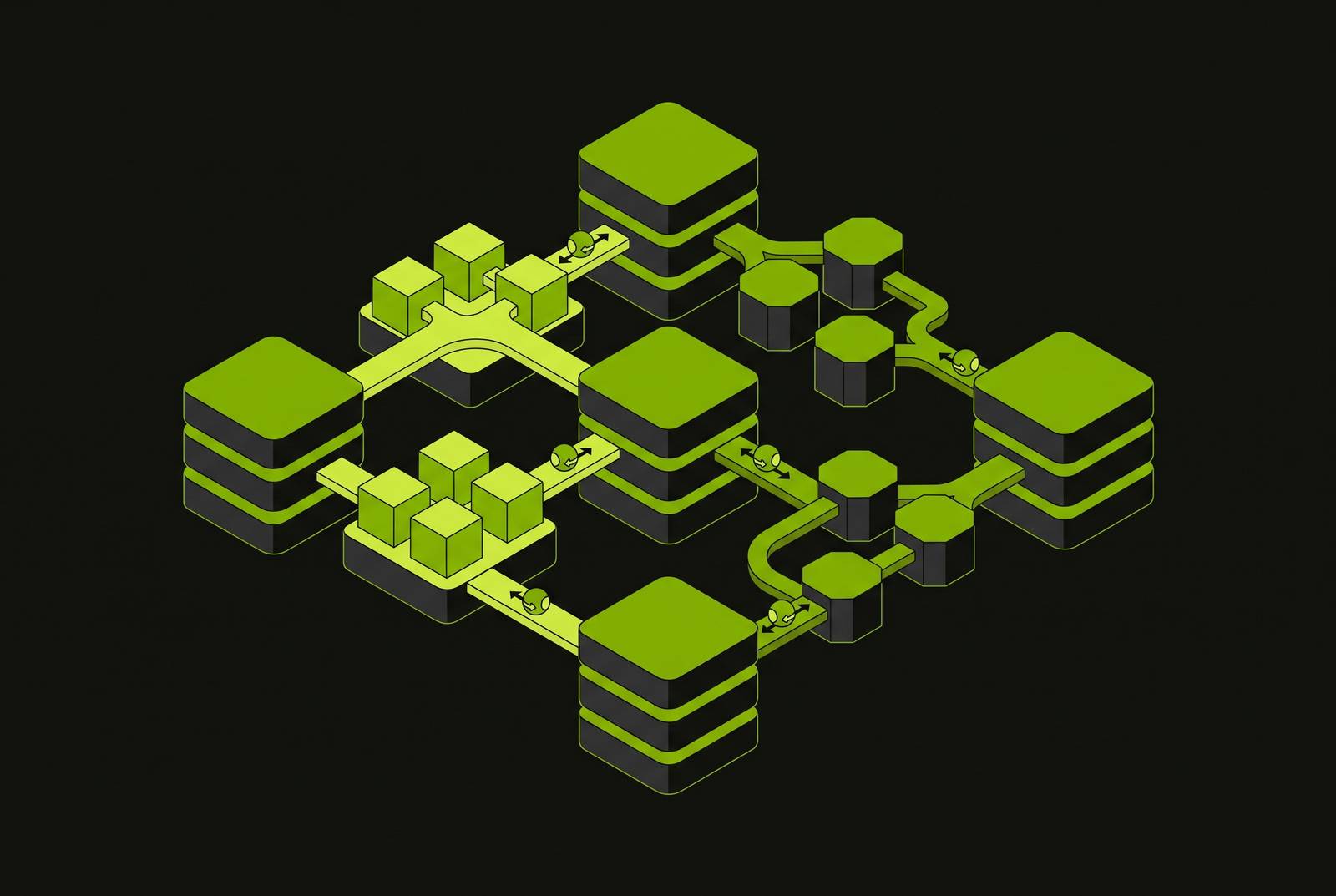
An agent container starts, passes its health check, and then fails to authenticate against GitHub, silently, because it was handed a classic personal access token built for a human sitting at a keyboard. That single failure captures the whole problem: the agent now owns the task from specification through implementation to pull request submission, acting as a sustained, programmatic presence in the Git graph rather than an occasional human contributor who logs in, commits, and logs back out. GitHub's June 2026 enterprise roundup treats this shift, from AI-assisted coding to governed agentic software delivery, as the central force behind the year's platform announcements, and frames it as a structural transition rather than a gradual change, one that demands new infrastructure thinking rather than incremental fixes to old tooling.
GitHub sync for agents versus GitHub sync for developers
Git sync tooling built for human developers was never designed with agents in mind. It assumes a person who reads diffs, tolerates the occasional merge conflict, and logs in interactively when a token expires. Every one of those assumptions, once an agent takes over, becomes a constraint instead of a convenience. Three failure modes result: authentication flows block non-interactive containers because classic personal access tokens don't work in agentic workflows; retry loops turn into a denial-of-service pattern once agents operate at machine frequency; and merge queues sized for the pace of human typing buckle once agents start generating pull requests at a volume no human team ever produced. They are the predictable result of pointing agent-scale traffic at infrastructure built for a much slower, much more forgiving kind of contributor, and they are the reason a distinct set of sync patterns has to exist rather than a set of tweaks to the old ones.
How GitOps became the operating context agents live in
Agents didn't arrive into a blank slate. They arrived into GitOps, the practice of treating Git as the single source of truth for both infrastructure and application state, which has become the dominant paradigm for cloud-native deployments, and agents have been dropped into it rather than designed for it from scratch. GitOps and Continuous Delivery for Cloud-Native Applications 2026 describes this maturity directly: GitOps has gone from an emerging practice to an established foundation for platform engineering, and that foundation is the context any agent sync pattern has to work inside, not around. Agents weren't designed into this world. They were dropped into it, running inside the same GitHub Actions pipelines that already govern human-authored code, subject to the same validation hooks, manifest checks, confirmation that a SOUL.md file exists, checks that a knowledge tree is well-formed, but carrying concurrency and statelessness properties nothing in that pipeline was built to expect.
In a monorepo, a policy file changed in one place is visible to every agent on its very next run, with no sync lag and no copy-paste drift between instances. It's structural to GitOps itself, a side effect of treating Git as the one place state lives. But that same structure has limits. GitOps was built around human commit cadence, human conflict resolution, and audit trails meant for human eyes. Agent concurrency, stateless ephemeral containers, and programmatic authentication are new demands GitOps was never built to anticipate, and nothing in the paradigm resolves them automatically.
The merge queue bottleneck when agents generate the PRs
The first place this all breaks visibly is the merge queue. Coding agents multiply the rate at which pull requests arrive, but the queue's service rate, fixed by however long CI takes to run, stays exactly where it was. Queueing theory describes what happens next without much ambiguity: as arrival rate approaches the system's capacity, wait times don't climb in a straight line, they climb toward infinity. Spotify's Honk system offers a real look at the scale involved: since early 2025, it has merged over 1,500 AI-generated pull requests across hundreds of repositories.
Retry behavior makes the arithmetic worse. If you tell an agent to get a pull request merged, it will re-queue the same change repeatedly until it succeeds, running the full CI suite on each attempt. At human frequency, that habit was mildly wasteful. But when agents do it, it becomes a serious drain on shared CI capacity. The problem compounds further because AI-co-authored pull requests carry measurably more latent issues than those written entirely by people, so flaky tests and failed merges increase exactly when the queue is already straining under volume.
Batching is the standard answer: running a group of pull requests through one CI pass together raises the group's combined throughput while the run itself takes no longer. That's the core mechanic behind merge-group strategies. GitHub's June 2026 enterprise roundup and Microsoft's APM project both demonstrate the same practical shape of this idea, a two-tier CI split where unit tests and binary builds run on every push, fast, fork-safe, with no CI secrets exposed, while integration tests and release validation run only inside the merge queue. GitHub's own engineering organization is the clearest evidence that this works at scale: moving from a deploy-train model to dynamic merge groups produced a meaningful drop in average time-to-ship across a codebase that merges nearly a thousand pull requests a month.
Even a well-tuned queue has a hard boundary, though. It guarantees an integrated, green main branch. It has no opinion on whether the tests passing on that branch actually assert anything meaningful, or whether the underlying design holds up. A rubber-stamped approval moves through the queue just as smoothly as a carefully reviewed one, and agents can produce a great many rubber-stamped approvals in very little time. That is why you need the auth and governance patterns below.
The six sync patterns that match how agents operate
Agents operating in cloud or isolated environments need sync patterns built around what they actually are: stateless, concurrent, non-interactive, and programmatic. Each of those properties breaks a different assumption baked into tooling built for human developers, and each pattern below targets one of those breaks.
The first pattern is stateless clone rather than persistent checkout. A long-lived working tree is a reliability hazard once dozens of agent containers are reading and writing concurrently, so ephemeral containers should clone fresh on every invocation instead of maintaining state between runs. Shallow clones using --depth 1 and sparse checkouts cut clone time and network cost for agents that only need part of the tree. Agent Sync, a TypeScript library and CLI, is a working example: it synchronizes a repository's agent instructions, skills, MCP servers, and full plugin packages across Codex, Claude Code, and Cursor through a checked-in manifest paired with a Git post-checkout hook. The manifest decides what belongs in the environment, and the hook rebuilds local state whenever a branch changes, so an agent never has to maintain its own configuration by hand.
The second pattern is manifest-driven skill and instruction sync. Agent instructions, skills, and MCP server bindings belong in checked-in files inside the repository, where they stay consistent across every agent instance. The same monorepo property from GitOps applies directly here: update the instructions file once, and every agent instance picks up the change on its next run, with no drift between instances to track down later. It also solves a quieter problem: skill bloat. You can see and prune skills tracked in a manifest, but skills buried in ephemeral per-instance configuration pile up invisibly.
The third pattern treats the pull request itself as a decision artifact you use for human checkpoints. Rather than building a custom approval dashboard, agents should route any decision that needs human review through a pull request, using the same branches, commits, and diffs, the same GitHub interface and CODEOWNERS governance a team already runs. GitAgent's set of 14 git-native patterns spells this out directly: when an agent learns something new or proposes a change, it opens a branch, commits the change, and opens a pull request, turning every agent decision into a reviewable diff instead of a line buried in a monitoring log. The governance payoff follows naturally: branch protection, required reviewers, and CODEOWNERS enforcement apply to agent-authored changes exactly as they already apply to human ones, with no new approval infrastructure to build.
The fourth pattern is non-interactive authentication built on scoped, short-lived tokens. Classic personal access tokens simply don't work here: the agent container starts, the health check passes, and authentication fails without any visible error, because the auth model was never built to be non-interactive in the first place. The governance layer forming around this problem includes per-repo OAuth scopes, policy-enforced model selection, and MCP allow-list matching, illustrated by the enterprise governance requirements converging across Claude Code, Codex, and Copilot CLI as documented in the AI CLI Tools Cross-Tool Comparison (2026-10-02). An evidence-gate pattern pushes this further still: only objective, machine-verifiable evidence can authorize a merge, never model judgment alone. Model judgment can veto a change, but it cannot approve one by itself.
The fifth pattern is tiered CI that separates what runs at agent-push time from what runs at merge time. Running the full integration suite on every single agent push is the fastest route to saturating CI capacity, so the split that works puts fast, fork-safe unit tests on every push and reserves heavy integration tests for the merge queue alone. Microsoft's APM project is the concrete version: Tier 1 runs on every push, covering unit tests and binary builds with no CI secrets exposed; Tier 2 runs only inside the merge queue, covering integration tests and release validation, with PR branches kept automatically up to date with main as a side effect. This tiering also directly limits the cost of retries: if a push only triggers the fast tier, a failed retry costs very little, and the expensive run happens exactly once, under the queue's control.
The sixth pattern is Git-backed memory, where consolidation fires on events rather than on a clock. Agent memory should live as files inside the repository, versioned and diffable, subject to the same review process as code, so it does not sit in an external database or vanish with the session that created it. GitAgent's human-in-the-loop pattern shows what this looks like in practice: the agent writes to its own memory file, pushes a branch, and the team reviews it as a pull request, so months later the reasoning behind a decision is still auditable straight from the Git log instead of reconstructed from whatever monitoring data happens to survive. Consolidation itself should fire on events, a commit SHA showing up in the transcript, a review thread closing, a workspace crossing a size threshold, rather than on a fixed timer, so memory tracks the agent's actual rhythm of work instead of an arbitrary clock.
How recent platform moves change what these patterns need to do
The first is GitHub Agent Merge, announced in June 2026. These two platform shifts are part of a broader convergence of the platform layer toward agents, moving faster than most teams have adapted their sync patterns, and both change the implementation details a great deal. GitHub's enterprise roundup for that month describes Agent Merge, autonomous CI monitoring, reviewer tracking, and auto-merge, alongside cloud and local sandboxes and agentic browsing, as a set of capabilities that make it realistic to direct many concurrent agents without losing track of which decisions still need a human to weigh in. For sync patterns, this means you can now put queue management and merge-state tracking at the platform layer instead of hand-coding it into each agent's own retry logic, so the kind of per-agent retry loop described earlier is not just wasteful, it is structurally unnecessary.
The second shift is the general availability of the GitHub Copilot SDK. The SDK takes over context management across turns, tool and command orchestration, model routing, MCP server integration, permission control, safety boundaries, and error handling, which frees teams to focus on defining agent skills and business logic instead of building that plumbing themselves. That changes where the real configuration work happens: skill files and domain constraints become the primary surface teams tune, while the SDK absorbs much of the session and auth machinery that Pattern 4's non-interactive authentication used to require building from scratch.
A quieter shift sits underneath both of these. Teams building agent runtimes, CLI tools, sandboxes, and security layers, the exact layer where these sync patterns actually execute, have converged on Rust, citing memory safety as a real advantage once agents start running with elevated permissions. If you design sync infrastructure, expect Rust-based runtimes to be what your patterns run on going forward, and that carries direct consequences for tooling compatibility and performance.
The broader AI CLI ecosystem is splitting along a related line. The cross-tool comparison (2026-10-02) shows platform-integrated tools, Claude Code, Codex, Copilot CLI, Gemini CLI, and Qwen Code, building managed session runtimes with enterprise governance, while community and independent tools, OpenCode, Pi, and DeepSeek TUI, build provider-agnostic, local-first alternatives. Sync patterns that stay manifest-driven, Git-backed, and non-interactive work across both tiers of that split, and that portability is what makes them more durable than any pattern built to depend on one tool's managed runtime.
The verification gap that sync patterns alone cannot close
None of the six patterns above answer the question that matters most once an agent-authored pull request reaches the merge queue: whether the change is actually correct, not merely whether it passed. A merge queue guarantees an integrated, green main branch, and tiered CI guarantees that the expensive tests only run once, at merge time, under control. Neither mechanism has any way to judge whether the tests being run assert something meaningful or whether the design behind the change holds up under real use. That judgment still depends on human reviewers reading the diffs that pattern three surfaces as pull requests, backed by CODEOWNERS and branch protection enforcing who gets to make that call. Evidence gates narrow the space further, because they refuse to let model judgment alone authorize a merge, but a gate that filters evidence is not a reviewer who understands the system being changed. The sync patterns describe how agent-generated work should move through Git. Whether that work deserves to move forward is still, and remains, a question for the people reviewing it.
Sources
- The Rust Shift: How GitHub's AI Agent Infrastructure Changed Languages
- GitHub - ARUNAGIRINATHAN-K/awesome-ai-agents-2026: ✨ Awesome AI Agents for 2026
- June ‘26 enterprise roundup
- GitOps and Continuous Delivery for Cloud-Native Applications 2026 - Calmops
- 📊 AI CLI Tools Digest 2026-10-02 · Issue #666 · datnguyenquy94/news-radar
- GitAgent: 14 patterns all AI agents should follow.
- GitHub - KentonParton/agent-sync · GitHub
- The Perfect Fusion of GitHub Copilot SDK and Cloud Native