Event-Driven Architecture Patterns for Agent Task Triggering
Four patterns let agent pipelines respond to events instead of polling for change.
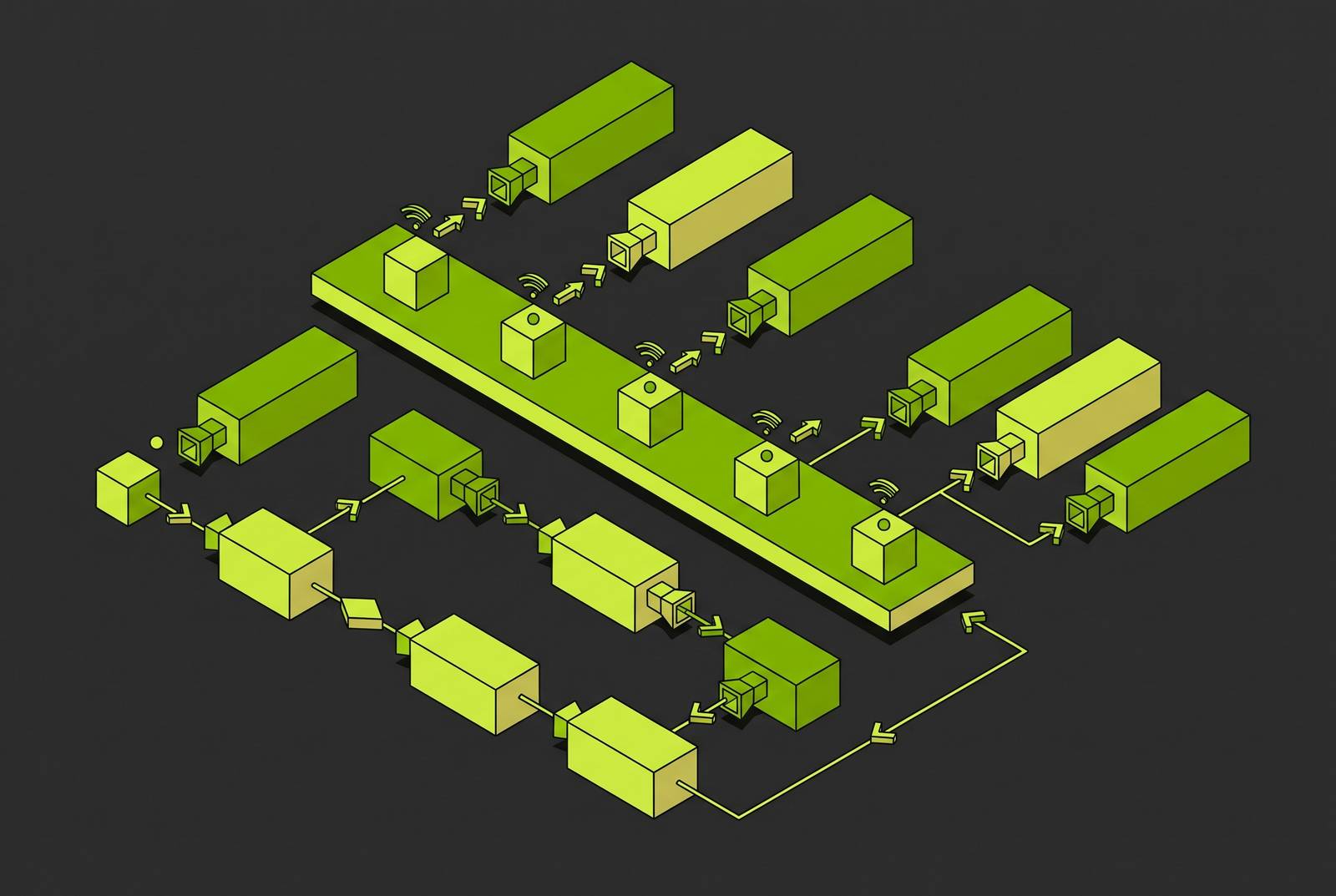
Event-driven architecture gives agent pipelines a concrete way to decide what deserves attention, what runs first, and what happens after an agent acts. Its four patterns for triggering work are event filtering, priority queuing, fan-out, and closed-loop feedback. Depending on these tradeoffs, a pipeline responds to useful signals or spends its compute amplifying noise.
Why agent pipelines stall without an architectural trigger model
Polling makes agents ask again and again whether anything has changed. That work continues even when nothing has happened. When a change does occur, the agent waits until the next poll before it can reason about it, introducing decision latency and the risk of acting on stale data. Rigid schedules impose the same separation between an event and the response it needs.
A polling or batch model may suffice for a single workflow, but dozens of agents compound both the infrastructure load and the cost of stale context. Sequential enterprise workflows create a related constraint because events pass from one system to the next, while agents need to consume them immediately and independently. Adding agents does not remove that dependency. Polling is how the system checks for change. EDA provides the architectural trigger model that lets a change start work.
What EDA actually provides: the subscribe-decide-act loop as the base triggering primitive
The subscribe-decide-act loop is the base unit of event-driven agent behavior. An agent first registers interest in specific event types. When a matching event is published, the agent receives a notification immediately. It then decides what to do, drawing on current context from other systems where needed. What the agent does usually creates another event that can start work elsewhere.
An inventory workflow makes the sequence concrete. A large customer order triggers an inventory agent to check stock, cross-reference demand forecasts and logistics data, and reorder where necessary. Events from the resulting actions can become inputs for downstream agents. The agents coordinate their work through events independently of a caller directing every step.
This separation is the foundation of loose coupling. Producers do not need to know who consumes their events, when consumption happens, or how consumers act. Events for a slow or failed consumer can queue without blocking the rest of the system, avoiding the failure dependencies of synchronous API chains. The base loop is necessary, but it leaves important choices unresolved. Those choices come up as more events arrive with different priorities.
Event filtering: preventing agents from being triggered by noise
An event can be valid without being relevant to a particular agent. Filtering scopes a subscription by event type, attributes, or conditions, and the broker matches those criteria before delivery. Without that boundary, every event on a stream can become an unnecessary activation.
The practical constraint is the agent’s context budget. Its context window is finite, so low-relevance events consume space that could support the decision at hand and degrade the signal-to-noise ratio of subsequent reasoning. Filtering at the broker costs less than activating the model and then asking it to reject input it does not need. The first tuning decision therefore concerns which events reach the agent at all.
That decision balances precision against recall. Narrow filters can leave out events the agent should act on, while broad filters let in noise that may create more downstream events. In a software factory, a merge-readiness agent should subscribe to merge group events rather than every event from activity in the repository. Once the pipeline knows which events the agent should act on, it still needs to decide which one to handle first.
Priority queuing: ensuring high-value events reach agents before low-value ones
When eligible events arrive faster than an agent or agent pool can process them, arrival order becomes a policy choice. Priority queuing assigns an event’s priority at publication or ingestion and delivers higher-priority work ahead of lower-priority work. Ordering alone has a limit, however. Preemption is the separate ability to interrupt lower-priority work when an urgent event arrives.
SAP’s Autonomous Event-Driven Multi-Agent Orchestration for Enterprise AI at Scale evaluates a minimal Task Manager with priority inference, preemption, and related-event merging. The paper reports a large reduction in high-priority queue latency, with the effect most pronounced at Enterprise scale, where the discovery space is largest and most confusable. Its evidence comes from a controlled simulation. The results characterize the tested systems, with production readiness still unestablished.
A retry, an escalation, and an alert may all concern the same failing job. Merging them before delivery reduces redundant activations while giving the agent a more complete account of the situation. The same paper reports that this capability improved Expected Answer Completeness by over twenty percentage points at Enterprise scale.
Priority also introduces a fairness tradeoff. When high-priority events keep arriving, lower-priority events can wait forever, so well-designed queues have starvation prevention. Aging moves low-priority events up after a wait that can be configured, so urgent work gets served first and less urgent work still gets a turn.
Fan-out: triggering multiple agents from a single event without creating coupling
Fan-out lets one published event activate multiple independent agent subscriptions concurrently. Each subscriber gets the event without needing to know that the others exist. A customer order can therefore trigger an inventory agent, a fraud agent, a finance agent, and a logistic agent in parallel. None needs another’s result merely to begin reasoning.
Synchronous orchestration creates the opposite dependency. An agent that calls downstream agents sequentially must know their addresses and wait for responses, exposing the chain to an unavailable participant. Broker-based fan-out removes those caller dependencies and makes an event reusable by multiple agents, services, and platforms. At scale, however, distribution itself needs sufficient throughput so the broker does not become the bottleneck.
Independence does not make additional activations free. Fan-out multiplies compute use and can produce competing or contradictory actions when subscribers have poorly defined scopes. Tight subscription filtering limits unnecessary participation, while a governance layer arbitrates conflicting outputs. The useful property is that each agent can do relevant work without forcing unrelated agents to wait.
Closed-loop feedback: using agent outputs as events that retrigger the pipeline
A closed-loop pipeline continues when the consequences of an agent’s action arrive as new events. Those events trigger further reasoning, allowing the system to refine its state beyond a single output. The response becomes part of the next input.
That continuity needs explicit limits on autonomous action. A process intelligence layer supplies workflow gates that distinguish what an agent may decide from what requires human approval. These gates stop, route, or escalate an event before the next action executes. Model-level constraints alone do not provide that architectural checkpoint. Without it, feedback can accelerate errors.
Production signals are especially valuable feedback because they show what happens when deployed code runs. When a deploy event triggers an agent that detects a production regression, the detection should become an event that re-enters the pipeline. A dashboard notification awaiting manual triage leaves that connection open. Routing the detection through workflow gates allows the next response to begin without abandoning control over what the agent may do.
How the four patterns interact and where pipelines go wrong when they are applied without discipline
The four patterns form interdependent layers. Filtering controls which events get in, priority queuing controls their order, fan-out controls which agents take part, and feedback links what happens to what gets decided next. A mistake in one layer changes the load on the others. Broad filters, for example, create spurious fan-out activations whose outputs can re-enter the pipeline and trigger still more unnecessary work.
This amplification can raise latency while reducing decision quality. A different failure appears when nominally separate agents still depend on synchronous downstream responses, reproducing the operational complexity of a distributed system with the brittleness of a monolith. Decomposition is not the same as decoupling. Similarly, a feedback loop without governance gates distributes actions without adequately controlling their consequences.
The SAP paper found that both DAG Plan & Execute and ReAct performed well at the small Persona registry scale but degraded at Enterprise scale. That finding reinforces the need to examine orchestration and context delivery as the agent population grows. More agents increase the number of agents to discover. A triggering design that works for a small registry is not, by itself, evidence that the same design will perform well with a larger one.
The practical diagnostic begins with what reaches the agent’s context window. Frequent receipt of events that require no action points to broad filtering, while delayed urgent work points to missing or misconfigured priority policies. Blocking on downstream responses indicates synchronous chains in place of independent delivery. When the same failures keep happening without changing how the pipeline behaves, the feedback loop is open. Separable infrastructure lets teams adjust the responsible layer without redesigning every other one.
Applying EDA patterns to a software factory merge queue as a concrete end-to-end case
The first boundary is the subscription that activates the merge-readiness agent. It should pick merge group events rather than commits, comments, and label changes from across the repository. Those other activities can consume context without advancing the merge. Filtering keeps the queue’s reasoning tied to the work it manages.
Priority matters when dozens of PRs generated by agents arrive at once. Handling events in the order they arrive leaves a high-impact fix behind low-priority chores, while a priority-aware queue can send the fix through first and batch lower-priority PRs that can go together. Batching changes the unit of validation. A single speculative merge commit groups several PRs so one shared CI run tests the build they produce together. The queue merges the batch only if it passes, catching interaction failures that per-PR checks can miss while reducing total CI time.
After a successful merge, fan-out starts the independent downstream work. The merge event should notify a deployment readiness agent, a dependency audit agent, and a test coverage agent concurrently. These consumers do not need a serial chain merely because they share a trigger. Parallel activation keeps post-merge latency from accumulating across separate responsibilities.
CI results then close the queue’s immediate feedback loop. A failure event should return as a signal that triggers diagnosis, an attempted fix, and resubmission, subject to the workflow gates governing autonomous action.
The more consequential extension reaches beyond CI into production. Post-deploy exceptions, performance regressions, and query issues should go into the same pipeline as first-class events. They show how the code behaves in ways that a passing build alone cannot prove. Feeding those signals back into queue decisions connects the software factory to what its code actually does after deployment, which requires infrastructure that can route runtime feedback as deliberately as merge events.
What choosing EDA patterns deliberately requires from infrastructure
Deliberate pattern selection requires separable, configurable infrastructure layers. The broker must allow fine-grained subscription filtering before it delivers events, so the agent avoids the cost of rejecting them. The queue must expose priority assignment, preemption, related-event merging, and starvation prevention as distinct policies. A FIFO queue cannot supply those behaviors merely by serializing arrivals.
Distribution must also remain independent of agent implementations. Adding a subscriber should not require changing the producer or existing subscribers, because that independence makes the architecture extensible without cascading changes. The feedback mechanism needs a production signal pipeline that treats runtime events as first-class inputs. Deploy failures, exceptions, and performance degradations need the same routing, filtering, and priority capabilities as other triggers, with governance gates controlling subsequent action.
The infrastructure choice is therefore a choice of behavior before it is a choice of vendor. Teams should put together a purpose-built event broker, an implementation of a priority queue, and a feedback mechanism with governance, rather than take the trigger model bundled with a platform built for workflows that run at a human pace. Agent throughput changes the operating requirements. Event volume, subscribe-decide-act speed, and feedback latency demand deliberate control over when agents reason.