When Monolithic DevOps Platforms Become a Bottleneck
AI agents are overwhelming pipelines designed for human-paced development cycles.
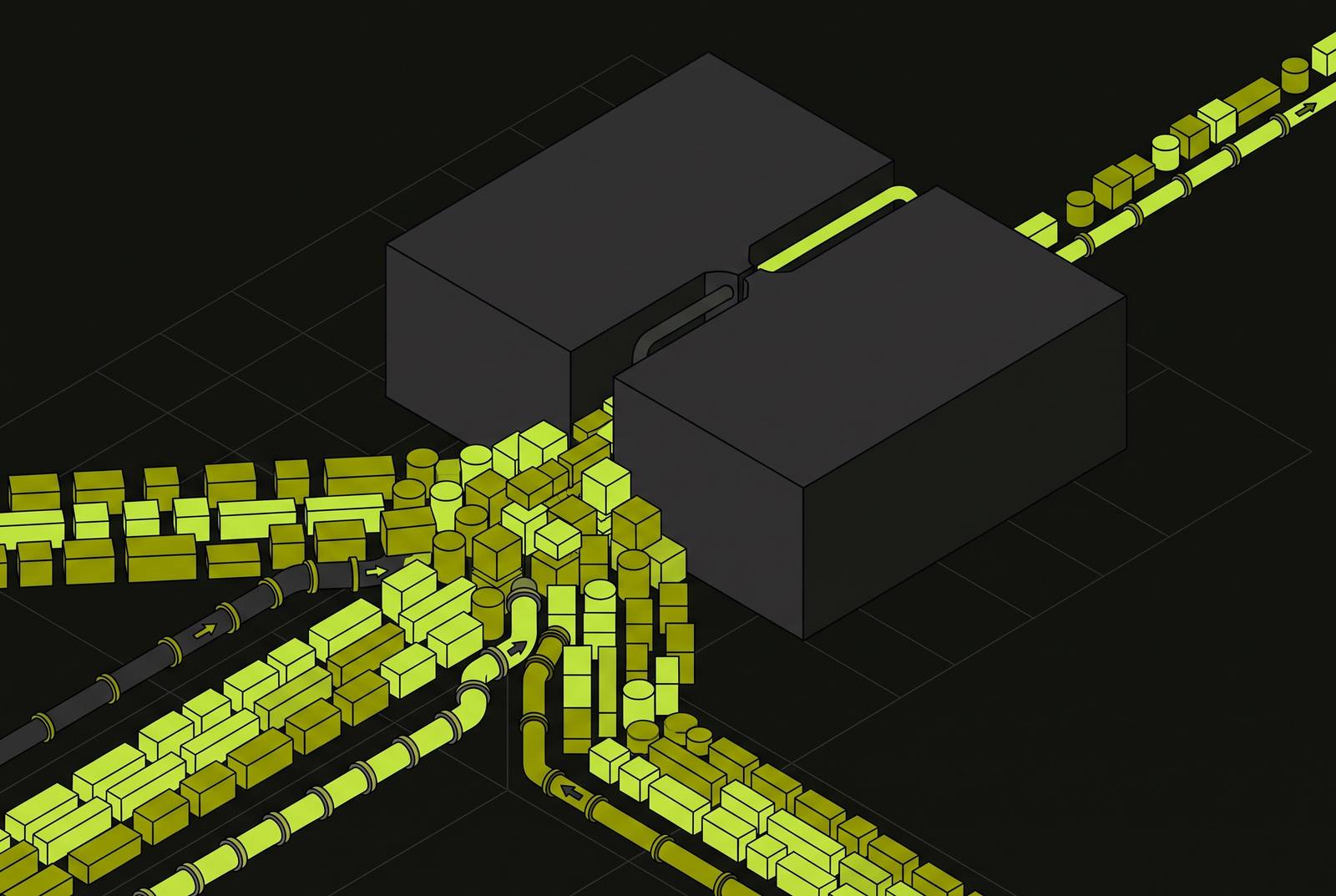
Agents are opening pull requests faster than the pipelines behind them can process those requests, and that gap is the subject of this piece. Monolithic DevOps platforms were not built badly. They were built for a cadence that no longer holds, and AI-generated output has broken that assumption at every joint. A platform built around one pipeline, one artifact, and one centralized governance layer works fine when a single developer produces a single PR and waits for it to clear. The same platform becomes structurally incompatible with its own workload the moment dozens of agents start producing PRs in parallel, around the clock, with no natural pacing between submissions. The arrival pattern is asynchronous, parallel, and continuous, replacing the serial, paced rhythm the platform was designed around.
The industry has already run a version of this experiment, in the opposite direction. A substantial share of organizations that adopted microservices architectures are now consolidating services back into larger deployable units, and the reason is not that microservices were a mistake. If a distributed system is poorly bounded, its operational overhead eventually overtakes whatever benefit the distribution was supposed to deliver. The lesson transfers directly to platform design. A DevOps platform that centralizes everything, pipeline, governance, artifact storage, into a single chokepoint, fails under concentrated load for the same underlying reason a sprawling, ungoverned mesh of microservices fails under coordination load. Both are collapses of a system under a load pattern its architecture never accounted for, just from opposite directions. One scatters authority until nothing coheres. The other concentrates throughput until nothing moves.
What follows traces where that mismatch actually surfaces in a working delivery pipeline: the merge queue first, then the CI/CD pipeline around it, then the version control layer beneath both, and finally the governance and observability model that was supposed to hold the whole thing together. Each is a distinct ceiling. Understanding where each one sits, and why it forms at that specific layer, is what makes it possible to remove rather than just route around.
Where the merge queue becomes the first hard ceiling
The merge queue is where the mismatch first becomes impossible to ignore, because it is the one place in the pipeline where arrival rate and processing rate are forced into direct competition. A serial merge queue is sized for how often humans submit work, so when agents start feeding it, it turns into a hard throughput ceiling, and the arithmetic behind that is unforgiving.
A fixed CI runtime sets a fixed maximum merge rate, full stop: if each merge requires a fixed block of CI time, the queue can only clear so many merges per hour, no matter how many are waiting. A team producing PRs at even a modest agent-driven pace can push arrivals past that ceiling, and when that happens, queuing theory says you don't get a gentle slope. Wait times do not climb in proportion to the overload; they climb sharply as the arrival rate closes in on the system's capacity, so small increases in load can produce disproportionate increases in wait time.
Retry behavior makes the problem worse, not just more frequent. An agent told to get a PR merged doesn't give up when a run fails. It re-queues, and every re-queue costs a full CI run, even when nothing in the code changed at all. A human engineer facing a flaky test might wait, investigate, or ask a teammate before resubmitting. An agent optimizing for task completion keeps retrying, cheaply and immediately, at a frequency no human workflow was ever built to absorb. At human submission frequency, that kind of retry waste is a minor inefficiency. At agent frequency, it starts to behave like a denial-of-service attack on the team's own merge queue. One documented case found that a substantial share of PR Gate runs were redundant second runs triggered against an unchanged commit SHA, so they wasted a meaningful amount of job-minutes, and that was on a team not yet running agents at any real scale. Scaling that pattern to dozens of agents working in parallel compounds the waste accordingly.
The instinctive fix inside a monolithic platform is to add more CI runners. That addresses raw throughput, but it does nothing for ordering, conflict detection, or intelligent triage. More lanes on the same highway still leave every driver stuck behind the same unmanaged intersection: agents still wait, still retry blindly, still collide with each other's changes, just with slightly more capacity absorbing the chaos before it becomes visible. What the queue actually needs is not more capacity but more intelligence: a system that can tell a genuine retry from a redundant one, prioritize merges by the risk they carry, and resolve conflicts without waiting on a human to step in. A monolithic queue builds a single linear path for every submission, so it has no way to make that kind of judgment call.
How CI/CD pipeline design breaks under agent-frequency code production
The merge queue is the most visible ceiling, but it is not the only one. The pipeline that feeds it was designed around an entirely different cadence, so when code arrives at agent speed, nearly every stage of that pipeline can become a bottleneck at once.
The older model assumed that most of a development cycle went into writing code, with deployment sitting at the end as a final gate: CI/CD existed to check work that was mostly already done. That assumption inverts once code starts arriving continuously. Integration and validation, not implementation, become the dominant cost of the cycle, because the code itself is no longer the scarce resource. Engineering analysis from 2026 frames CI/CD as the next bottleneck for exactly this reason: production has shifted from writing code to integrating and validating it, and the pipeline built to check occasional human output was never sized for that shift.
Test suite duration illustrates the shift concretely. In the old rhythm, a slow overnight test run was mostly an inconvenience, something a developer tolerated because they weren't waiting on it anyway. If a team ships on green and an overnight suite doesn't report until midnight, that suite is surfacing a bug that shipped hours earlier, and by the time anyone finds out, a stack of additional agent-generated PRs has already merged on top of the broken state. It's a feedback-loop failure that compounds with every agent PR that cleared the queue while the suite was still running, each one potentially building on code that was already broken.
Some of the industry's response has been to speed up diagnosis within a single pipeline stage rather than redesign the pipeline itself. GitLab Duo Fix CI/CD, which reached general availability as part of GitLab 18.8, works this way: when a pipeline run fails, the tool reads up to 150 KiB of the failure logs, works out a likely root cause, and proposes a fix as a merge request, cutting down the time a human spends triaging an individual failure. That is a genuine improvement in diagnosis speed, but it operates inside one stage of one pipeline. It does not touch the larger mismatch between how fast code arrives and how long the full pipeline takes to validate it end to end.
The architecture itself is the deeper issue, not any one stage's speed. A monolithic platform routes every workstream through the same pipeline, the same observability layer, and the same deployment surface, so parallel agents end up competing for identical shared resources, with no isolation between them and no way to prioritize one workstream over another. That contention does not stop at the CI/CD layer. It runs straight down into the infrastructure that stores and serves the code those pipelines are built on.
Version control becomes a shared infrastructure bottleneck at agent scale
Git itself sits beneath the pipeline, and almost nobody thinks about it in a human-paced workflow, but once hundreds of automated systems start reading from and writing to the same repositories at once, it becomes a measurable constraint. Infrastructure built around a human's clone-and-fetch habits starts accumulating I/O and latency costs that compound as soon as the number of clients hitting it stops looking like a team and starts looking like a fleet.
At sufficient scale, ordinary Git workflows run into physical limits. Cloning a large repository, keeping a local checkout current, and running repeated fetch and push cycles all cost compute and I/O, and that cost gets paid again, independently, by every automated system doing it in parallel. CI caching is supposed to soften this, but caching carries its own overhead: infrastructure to maintain, manual upkeep, and cold-start latency whenever a cache misses. Thousands of independent clone and fetch operations hit the same upstream Git servers, and that turns those servers into a shared scalability bottleneck for the entire organization, not a problem isolated to one team's pipeline.
Two engineering responses, built by teams who hit this wall directly, show what you get when you build a purpose-built answer to this problem. Cursor's team described the dynamic without softening it: agents have changed how software gets built, and in important ways they've made the underlying infrastructure problem worse, producing more code, more PRs, and more CI runs than the systems around them were sized for. Their response was Origin, a Git-based code-hosting platform, and they released it in August 2026. Origin's storage engine, Continuity, handles pushes by uploading them into S3 as a write-ahead log of immutable objects, bundling changes together for faster throughput rather than treating every push as an isolated, synchronous operation against a single server.
Neither team tried to tune the existing system harder; both identified the specific layer where a human-centric design assumption was buried, the server, the clone pattern, the caching model, and replaced that layer outright, rather than adding capacity on top of an architecture that was never going to hold. That is the same instinct composable infrastructure applies everywhere else in the stack: find where the old assumption lives, and swap the component built on it, rather than patching around it indefinitely.
How agentic workflows break monolithic platform governance and observability
Throughput is only one half of the mismatch. The governance model assumes a human is always the one making decisions, and adding CI runners or faster Git servers cannot fix the ways that assumption breaks.
Agent use splits into two very different modes, and each one needs a different kind of oversight. In synchronous use, a developer stays present while the agent edits files, runs commands, and reports back, so the human remains the decision node even though the agent is doing the typing. In asynchronous use, the developer delegates a task and moves on to something else, and the agent operates inside a cloud or isolated environment, making decisions and taking actions with nobody watching in real time. Gartner's May 2026 overview of enterprise AI coding agents treats autonomous execution, context orchestration, and governance across the full software development lifecycle as the defining traits of this category, and evaluates products on dimensions including code review, testing, deployment, and analytics. Every one of those dimensions presupposes a governance layer that most monolithic platforms were never built to provide.
Multi-agent systems compound the mismatch further. Organizations are increasingly running multiple agents in parallel, each one reasoning inside its own separate context window, because that gets better results than a single agent working alone. A monolithic CI/CD pipeline built around one serial merge queue is architecturally at odds with that pattern from the start: it takes work that was deliberately designed to run in parallel and forces it back through a single-file line, undoing the benefit the parallel design was meant to deliver.
A visibility problem compounds this: most platforms surface none of what agents are doing. Agents using tools generate transcripts, logs of which skills they invoked, and execution traces, and most platforms don't surface any of it anywhere a human can see. Without insight into which tools an agent actually reaches for, which it ignores, and where it fails without raising any alarm, platform teams cannot tune the environment an agent operates inside or identify which capabilities are dead weight slowing execution down. Agent transcript analysis is not a debugging luxury reserved for teams with time to spare. Once agents are producing the majority of an organization's code, it becomes an operational requirement on the same level as monitoring a production service.
The distinction that matters here is conceptual. If an organization treats agents as just a faster version of an existing developer tool, it may pick up some local efficiency gains and little else. Organizations that recognize agents as a new execution layer, one that needs engineered context, controls, verification, and governance built around it specifically, are the ones positioned to use that layer safely at scale. A monolithic platform offers no native surface for that second kind of work, because it was never built with a non-human primary actor in mind.
The developer cognitive load cost of fragmented toolchains assembled without a coherent model
The natural reaction to hitting these ceilings is to bolt a new tool onto whatever is already failing; doing so produces a pile of disconnected tools that multiplies the cognitive load on developers and platform engineers without resolving the structural problem causing the ceilings.
Patching around a monolithic platform's limits instead of replacing the failing layer produces tool sprawl. The average project already runs a wide array of tools, and most teams managing even a moderate deployment end up responsible for hundreds of configuration files. Configuration drift, constant low-level toil, and a tax on attention follow, working against what platform engineering is supposed to deliver.
Sprawl and composability both involve using more than one tool, but they are not the same thing. Composability means assembling purpose-built components that share a coherent underlying model, programmable and interoperable at boundaries someone actually designed on purpose. Sprawl means adding tools reactively, one at a time, each one solving a narrow local problem while quietly adding its own integration surface, its own configuration language, and its own distinct way of failing. A team can end up with twice as many tools and half as much clarity about how the whole system behaves.
That fragmentation carries regulatory weight as well as developer frustration. More integration points mean more surface area for configuration drift. The 2026 DevOps trends analysis names fragmented tooling as an explicit driver behind the broader move toward dedicated platform teams, because it drives up regulatory risk. It is a governance failure with the same structural root as the merge-queue ceiling, the pipeline cascade, and the version-control bottleneck described above: a system assembled around assumptions that stopped matching reality, patched piece by piece instead of rebuilt where the mismatch actually lives.