How Disaggregated Infrastructure Changes Agent Pipeline Design
Separate compute, storage, and execution to fix agentic pipeline design.
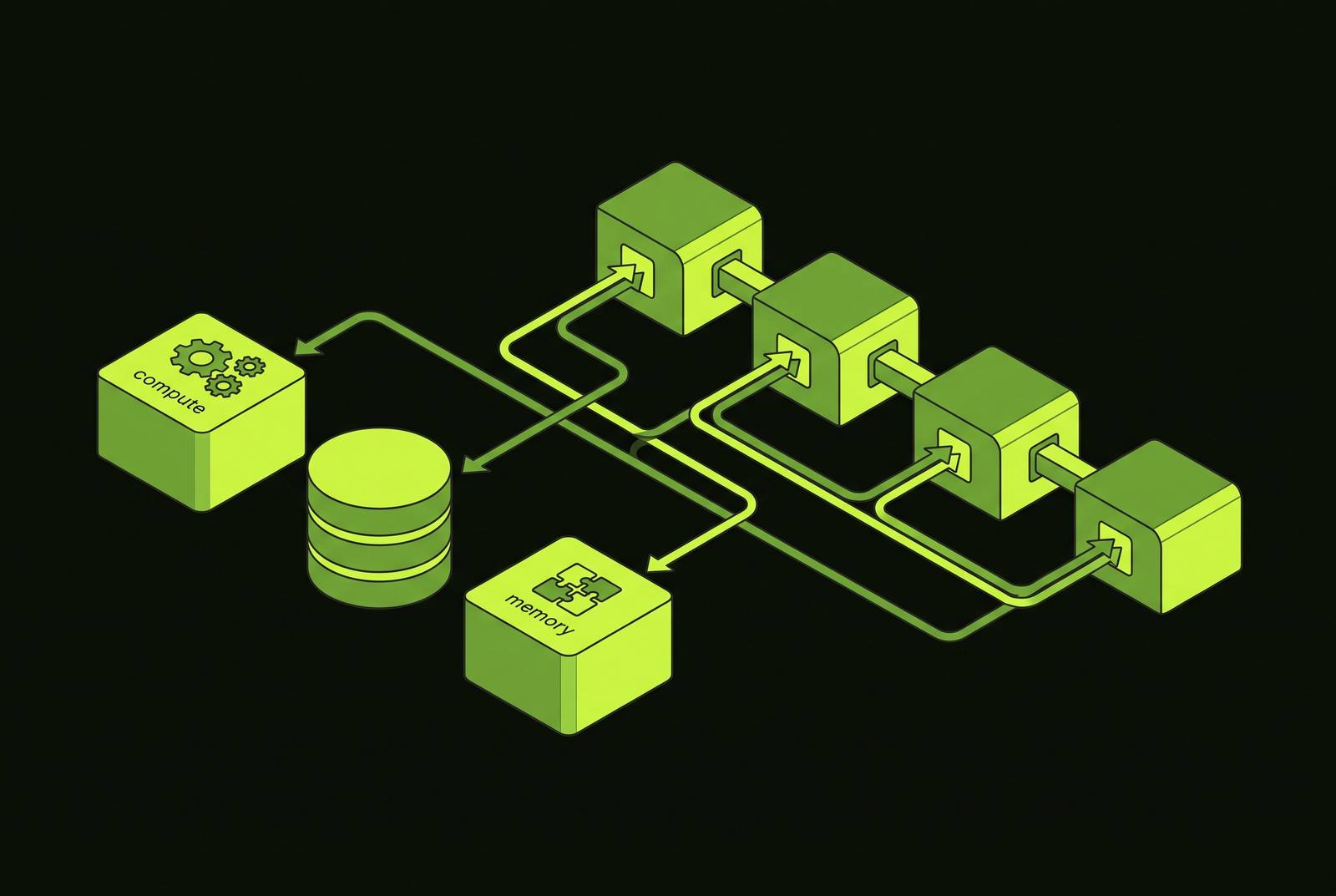
Disaggregated infrastructure changes how agent pipelines must be designed. When compute, storage, and execution context can be decoupled and scaled on their own, pipeline stages have to be built as independent units with explicit, versioned contracts between them, not as a single sequence that assumes everything sits in one place. This matters because the pipelines most teams run today still assume co-location, and that assumption is what breaks first.
Why monolithic inference stacks break under agentic workloads
Agentic inference asks a GPU to do two jobs that want opposite things from the hardware. Prefill, the phase where a model reads and processes the prompt, is compute-intensive and rewards high tensor-core density along with large on-chip memory. Decode, the phase where the model generates tokens one at a time, is bound by memory bandwidth instead of raw compute, and it needs fast, low-latency access to key-value caches whose access patterns are hard to predict in advance. A single GPU built to be good at one is, by construction, mediocre at the other. Research out of Imperial College London and the University of Cambridge, built on simulation of prefill, decode, attention, and feed-forward network specialization, confirms that prefill and decode behave in substantially different ways and need distinct compute and memory-bandwidth profiles, to the point that a homogeneous GPU system struggles to keep up with agentic inference.
Agentic workloads make the mismatch worse because decode doesn't run in short, bounded bursts anymore. A tool-calling agent loops through reasoning steps, calling tools, reading results, and generating more tokens. Decode runs nearly continuously across a multi-turn interaction. Each additional reasoning step compounds the hardware mismatch, because the system never gets to reset between bursts. Stack onto that the fan-out effect: a single workflow that spawns several sub-agents, each making multiple LLM calls of its own, produces a volume of inference traffic far larger than the size of the original input would suggest. At the AI Infra Summit 2026, NVIDIA VP of Hyperscale and HPC Ian Buck named the resulting design challenge directly: "No AI model, except for maybe the smallest ones, fits on a single GPU. You have to design a compute token factory end-to-end, CPU, storage, GPU, and networking issues have been the biggest challenges over the last two years as we start building AI factories." A monolithic stack, one that treats prefill and decode as a single undifferentiated job running on the same hardware, cannot serve both phases well at once, and agentic workloads are what expose that limit.
What disaggregation means at the infrastructure level
Disaggregation means decoupling pieces of the stack that architecture once assumed would live together, and making each piece an independently addressable, independently scalable service. It applies at the compute layer, the storage layer, and the agent execution layer, each in a different but related way.
At the compute layer, disaggregated serving sends prefill and decode to separate, specialized hardware clusters rather than forcing one GPU type to handle both. At the storage layer, compute and storage separate at the architecture level rather than at the level of a single workaround. Storage becomes a service defined in software, exposed through APIs and orchestration layers, and attached to compute only as needed. You can make this practical with high-speed fabrics, networked NVMe access, and cloud-native control planes, for workloads that once needed storage physically local to the compute doing the work. NetApp Novus, announced September 29, 2026, illustrates the pattern directly: it separates metadata from the data path, which lets performance, capacity, and concurrency scale on their own under a single namespace, built on industry-standard NFS.
At the agent execution layer, cloud-native agent platforms treat the execution context as something you can discard and attach. Anthropic's Claude Managed Agents handle sandboxed code execution, checkpointing, credential management, scoped permissions, and end-to-end tracing, so an agent's state is managed by the platform rather than locked into one runtime. Agents reach compute, storage, and tools through APIs and MCP servers instead of a shared process space. Across all three layers, the same shift happens: a component boundary that infrastructure once treated as implicit becomes explicit, addressable, and governed by a contract.
Why pipelines built on co-location assumptions fail
Most agent pipelines in production today were built on an assumption nobody wrote down: that compute, storage, and execution context share a process boundary. Disaggregation removes that assumption, and the pipeline fails at every point where it quietly depended on it.
A pipeline stage that reads from a local cache and hands state to the next stage inline has no latency budget set aside for a network hop, because its design never accounted for one. If a stage treats the Git repository as if it were a local file system, it breaks once storage moves remote and access has to run through an API instead of a direct read. A CI pipeline can assume a single machine's file system persists from one step to the next, but if each step actually runs in its own isolated, short-lived VM, that assumption breaks, because it was never true once the steps separated.
The clearest and most visible version of this failure in software factories is the Git ledger bottleneck. When humans submit changes, the gap between serialization locks on the repository is large enough that nobody notices it as a constraint. When machine-generated commits compete for that same lock simultaneously, the window to merge shrinks to milliseconds. This is a coupling failure: pipelines designed to handle one or two diffs a week have no capacity for the volume that agentic systems generate on an ordinary afternoon.
A second failure runs quieter but does comparable damage. When compute and storage separate, you have to engineer metadata consistency across components directly, because shared state can no longer handle it incidentally. The two failures compound. Ten agents can produce ten plausible diffs before lunch, and when they do, the constraint doesn't disappear just because the generation step got faster. It moves: to review queues, to CI capacity, to flaky test environments, to branch policy, to cost ceilings, and to the finite human attention needed to decide what actually deserves to merge. Mirantis's analysis of agentic AI infrastructure names the underlying pattern precisely: the limiting factor in production agent deployments is rarely the model itself. Orchestration, retrieval latency, observability, tenant isolation, rollback, identity management, and cost control under sustained load hold up or collapse an agentic system once the volume arrives.
What composable pipeline stages with explicit contracts look like
The right response to disaggregated infrastructure is to redesign pipeline stages as independent units, each with an explicit, versioned contract at every boundary where it meets the next stage, rather than rebuilding tight coupling at the software layer to recover the old simplicity. Every stage owns its inputs and outputs as defined interfaces, so it doesn't rely on shared state that happens to be sitting nearby.
A prefill stage contracts to deliver a populated KV cache to a specific address, and a decode stage contracts to consume it from that address. Neither stage assumes the other is running on the same hardware, and the contract is what makes that assumption unnecessary. A code retrieval stage contracts to return a file snapshot at a given revision, and the agent execution stage contracts to operate on exactly that snapshot rather than on whatever happens to be sitting on disk at the moment it runs. Under this model checkpointing is mandatory: if a stage can't restart from its last checkpoint, the contract between it and the next stage can't be honored once something fails.
The Model Context Protocol is what makes these contracts portable across vendors, so you don't need custom work for each integration. A Futuriom analysis of agentic infrastructure operations states the dependency: in multi-agent environments, without a shared standard, every integration turns into its own custom project, and the overhead of maintaining agent-to-infrastructure connections eats into the value that automation was supposed to deliver. MCP gives agents and developers a common interface into the same underlying platform, its applications, resources, relationships, and operational state, through different surfaces: portals, CLIs, and APIs for people, MCP servers for agents.
Short-lived, isolated execution contexts are replacing persistent shared environments for the same reason. Cursor's Cloud Agents run in isolated VMs and send results back as pull requests, and the execution context is built to be ephemeral from the start, not ephemeral by accident. Anthropic's Claude Managed Agents handle state management at the platform level: developers define tasks, tools, and permissions, and the platform handles execution and state, which makes the agent stage stateless from the pipeline's point of view.
That composability has to resolve somewhere at the pipeline's output boundary, and tiered merge policies are that resolution. Agents act within scopes defined in advance, and engineers configure explicit escalation thresholds, so a change needs a human decision only when it crosses one. This reflects bounded autonomy working as intended. Getting that boundary right depends on being able to see what's happening at every stage that feeds into it. That's why observability becomes unavoidable.
Observability across component boundaries requires its own infrastructure layer
If no one can verify, continuously, whether contracts between pipeline stages are being honored, the contracts don't work. Disaggregation makes that check harder, because failures and slow degradation build up in the gaps between components, where no one notices them.
Storage disaggregation's latency behavior is the clearest case of an observability problem hiding in plain sight. Remote storage can show a perfectly healthy average response time even while a rebalance, a failover, or a noisy-neighbor spike hurts a workload badly in ways the average never shows. When teams save money by not overbuilding their hosts, they often give some of that savings back in fabric upgrades, congestion control, and the tighter latency observability needed to catch the spikes the averages hide. Metadata observability is its own requirement, separate from observability on the data path, because the two can drift out of sync in ways that neither one alone will reveal.
Agent transcript analysis is the observability layer specific to the execution stage itself. A transcript records what the agent said, or what the model appears to have intended, but it does not prove that the corresponding action actually occurred. Production monitoring catches the drift between stated intent and real behavior that evaluation benchmarks are not built to catch, because benchmarks test the model before deployment, not the live system under load. A fact generated anywhere in the pipeline needs one clear owner and one replay path back to it. If the system can't reconstruct that fact later, it doesn't actually own it, no matter how confidently a transcript or a log implies that it does. You need to enforce the contract, not just patch over a logging gap. The Agentverse gap analysis lists observability as one of eight categories of missing infrastructure capability across current agent cloud platforms, part of 62 gaps identified in total, so observability remains an open problem in production agent deployments, and the industry has not already solved it.
The merge queue as critical contract enforcement point in a software factory
In a software factory where agents generate code continuously across execution contexts that are themselves disaggregated, the merge queue stops functioning as a scheduling convenience. It becomes the one place where you test every contract made upstream against reality.
The Git repository works as a single ledger, and serialization at the point of merge is unavoidable no matter how parallel the pipeline feeding into it has become. Parallelism upstream doesn't remove the bottleneck at the ledger; it just means more work arrives at that single serialization point at once. When machine-generated commits compete for that same lock simultaneously, the window available to merge any one of them shrinks to milliseconds. It's the direct consequence of disaggregated, parallel execution feeding into an output that, by the nature of a version-controlled repository, has to stay serialized, not a tooling shortfall to fix with a better merge tool.
A merge queue built around human pacing fails once agentic load replaces it. CI failures, merge conflicts, and queue management decisions used to happen rarely in a human-driven pipeline, but they become constant, high-frequency operational work once agents generate changes around the clock. Human review at this specific boundary turns into the bottleneck, and not because the people reviewing are slow by nature. It happens because reviewers have to make low-judgment, repetitive decisions at a frequency that matches machine output rather than human pace.
The fix is to separate decisions that need human judgment from the routine mechanics of managing the queue itself. Low-risk, well-understood categories of change, such as dependency bumps or test-only diffs, can merge automatically once they clear the defined checks, while changes that carry real judgment calls route to a human reviewer. That separation is what keeps the merge queue functioning as the contract enforcement point it needs to be, rather than collapsing under volume the moment agents start producing at machine speed.